
Isfahan, 2 days in the highlight of Iran - Part I: Naqsh-e Jahan Square, Grand Bazaar & Chehel Sotoun Palace
Former capital of Persia for over a hundred years during the Safavid dynasty, Isfahan is today one of the most impressive cities of modern Iran.
In its central Square, Naqsh-e Jahan, you will find one of the most outstanding open spaces in the world, comprising the main historical sites of the city and declared a UNESCO Heritage Site due to its architectural and historic significance.
During my first day in Isfahan, I explored the central area around Naqsh-e Jahan Square to discover its magnificent mosques, endless bazaar and picturesque gardens and palaces. Check out the first part of my visit to Isfahan, the highlight of Iran!
How to get to isfahan
I reached Isfahan from Kashan with a private transfer organised by TAP Persia, which included a stop at the Fin Garden of Kashan and Abyaneh, a beautiful village located 87km south from Kashan. Check out my post from Kashan to Isfahan: Fin Garden & the red village of Abyaneh!
TAP Persia is a tour operator whose purpose is to bring foreign guests in Iran and make them feel at home. They offer all type of services that include guided tours and hotel, bus and flight reservations. They accept payments outside of Iran through PayPal, so they’re a great option to book your transportation. I used them for all my bus tickets as well as my flight from Shiraz back to Tehran and they’re very reliable.
Fortress on the way to Isfahan
The distance between Kashan and Isfahan is 205km, so the journey takes approximately 2h 20m. With the stops in Fin Garden and Abyaneh, the journey will take most of your day, since the tour is private you decide your timing! I left Kashan around 9am and got in Isfahan by 5pm, just before sunset.
If you’re also travelling from Kashan but prefer going straight to Isfahan, TAP Persia can help you book VIP bus tickets.
Isfahan also has an international airport, with flights arriving from some major capitals and most cities in Iran. The airport is located 27km east from Naqsh-e Jahan Square, so it will take you about half an hour to reach most destinations in central Isfahan. To order a taxi, try to get mobile data and download Snapp, the local and very recommended version for Uber.
Isfahan also has an international airport, with flights arriving from some major capitals and most cities in Iran. The airport is located 27km east from Naqsh-e Jahan Square, so it will take you about half an hour to reach most destination in central Isfanan
History of Isfahan
What today is Isfahan started as a small settlement that developed during the Elamite civilisation, a pre-Iranian civilisation located in the far west and southeast of Iran.
When Cyrus the Great unified the country into the Achaemenid Empire in the 6th century BC, Isfahan became a centre of religious tolerance due to its religious and ethnical diversity.
After the Achaemenid Empire fell to Alexander the Great, the city was ruled by the Parthians, who continued the tradition of tolerance. They ruled until 224 BC, when the Sassanids took power until 651 AD. The city was then known as Aspahan or Spahan, seeing a revival of Iranian culture and the Zoroastrian religion.
The Arabs conquered Isfahan in 642, but the city only gained importance during the Safavid period between the 16th and 18th centuries. It was during this period that Shah Abbas I rebuilt the city and constructed most of today's historic sites. The Shah moved the capital to what was named Ispahan.
Naqsh-e Jahan Square, built during the Safavid Empire
During the 16th and 17th centuries, thousands of migrants and deportees from the Caucasus settled down in the city, creating enclaves of Georgian, Circassian and Dagestani descent. Large communities of Armenians also made Isfahan home during the Safavid era, creating the Armenian quarter of New Julfa with its beautiful Vank Cathedral.
The city started to decline in the following years, especially after the capital was moved to Tehran in 1775. In the 20th century, a large number of people from southern Iran was resettled in Isfahan, and then once again in the 1980s during the Iran-Iraq War.
Today, the city is well known for its fine carpets, handicrafts, textiles and sweets. Isfahan's glorious past also makes it one of the unmissable highlights of Iran, with locals and foreign visitors getting fascinated by its incredible architecture with every step they take.
Arrival
I arrived in Isfahan from Kashan earlier than I expected just after 4pm. My driver left my at the Iran Hotel where I would stay or 3 nights, and after checking in and leaving all my stuff, I decided to head to Naqsh-e Jahan Square before it got dark.
Since my trip took place just after Nowruz, the Persian New Year, most Iranians were on a long 2-week holiday, so the entire city was in celebration. The surrounding streets and the beautiful gardens in Naqsh-e Jahan Square were filled by local tourists, families and friends having a picnic and just enjoying the views.
I fell in love with Naqsh-e Jahan Square since the very first moment that I step on it. The dimension of the square and the stunning buildings around it elevate it to a different level; by far one of the most impressive open spaces that I’ve seen during my travels.
I stayed walking around the square for a good two hours until it got dark, when the buildings light up and the incredible tile work looks as its best in an incredible show of colours and shapes.
Naqsh-e Jahan Square
Entrance of Shah Mosque
Shah Mosque at night
Day 1
After an amazing breakfast at the Iran Hotel, I head early in the morning back to Naqsh-e Jahan Square to really start exploring Isfahan. Most tourist attractions are located right at the square, so you can easily spend the first day in the city visiting all the places of interest around the square and the bazaar. The ensamble is so outstanding that it was declared a UNESCO World Heritage Site in 1979.
My first stop in the square at its biggest building, the Shah Mosque. Finished by the Safavid dynasty in 1629, it’s one of the masterpieces of Persian architecture. Foreign tourists must pay an entrance fee of 500,000 rial (approx. €11).
The mosque was planned after the Persian Shah decided to move the capital of the country to Isfahan in 1598, replacing a much older Jameh Mosque. The Shah envisioned the new construction as a display of grandeur, building not only the biggest dome in the city, but also two religious schools and a winter mosque inside the main building.
The mosque is accessed through the main iwan, built as a 27 meters high semicircle that resembled a half-moon, covered with turquoise decoration and tile-work. At each side stand a 42 meters high minaret topped with wooden balconies used to call worshippers to pray.
Shah Mosque
Entrance iwan
Minaret
As you cross the entrance iwan, you will reach the main courtyard with a large pool at the centre. On each side you will find two additional iwans, completed by a third-one in the middle with two minarets that gives access to the main building with the impressive dome.
The interior of the mosque is absolutely breathtaking. I had already been surprised by the elaborate decoration of Persian mosques in Tehran and Kashan, but Shah Mosque in Isfahan brings Islamic art to another level.
The dome of the main building, raising over 53 meters, was the tallest in Isfahan when the mosque was complete. Covered in tiles, it reflects the light of the sun, allowing former travellers of the Silk road to see it glittering from multiple miles away.
The courtyard and dome are designed to generate perfect acoustics, that can be used by the imam to sing and pray. During my visit, one of the guides with a local tour stood in the middle and started to sing a prayer, creating an incredible effect of sound.
Main courtyard
Tile-work
Dome
Iwan in the courtyard
Internal decoration
Walking around the square in a clock-wise direction, my next stop was Ali Qapu Palace. Finished in 1597, this construction served as the official residence of the Persian Shah from the Safavid dynasty. With a height of 48 meters, it has six different floors reached through a spiral staircase.
The entrance fee for foreign visitors also costs 500,000 rial (approx. €11). For what it offers, I thought that the price is quite high, especially if compared to the impressive Shah Mosque, as most of the rooms are almost empty with the exception of some paintings on the walls as you exit.
That said, the historical relevance of the palace and the amazing views of the square from the balcony still make the visit worth it if you have some extra time and money to spend.
Ali Qapu Palace
Decorated walls
Columns in the balcony
The palace was built in different stages over a period of 70 years. One of the most important additions took place during the second phase, when the Reception Hall was built. This room, used by the Shah to meet with his guests and delegates, was designed in the traditional cubical shape with a pond in the middle, decorating the interior with beautiful paintings.
However, the main attraction of palace is the beautiful balcony with views to Naqsh-e Jahan Square, which was used by the Shah to watch polo games and horse races down in the square. During my visit, even I could watch a polo match taking place in the square, just next the entrance to the Grand Bazaar!
Reception Hall
Painting on the ceiling
Painted walls
View of Shah Mosque
Entrance to the Grand Bazaar
Naqsh-e Jahan Square & Sheikh Lotfollah Mosque
Right across Ali Qapu Palace you will find Sheikh Lotfollah Mosque, another architectural gem built during the Safavid Empire in 1619. The entrance fee here is quite lower at 200,000 rial for foreign visitors (approx. €4).
Sheikh Lotfollah Mosque was the first monument completed in Naqsh-e Jahan Square and was originally built as a private mosque for the royal family, contrary to the Shah Mosque, which was intended for the use of the general public. This explains why the building is much smaller than Shah Mosque and doesn't have any minarets.
The Shah accessed the mosque through an underground tunnel that connected it to Ali Qapu Palace. The main entrance to the building was built with marble simulating the shape a recessed half-moon, using tiles and calligraphy to decorate the upper part of the arch. The construction is topped with a 32 meteres single dome, also richly decorated with tiles.
Compared to Shah Mosque, Lotfollah Mosque is much smaller, as it has no courtyard or interior iwans, however, the internal decoration has absolutely nothing to envy. The building is formed of a single chamber under the main dome, decorated with an incredible display of arabesque patterns that become smaller and smaller.
Sheikh Lotfollah Mosque
Decoration on the walls
Interior
Dome
Iran is well known for its beautiful bazaars, and the one in Isfahan is not an exception. Built in 1620 during the Safavid era, Isfahan’s Grand Bazaar is one of the largest and oldest in the region, extending for over 2km.
The main entrance is located on the norther side of Naqsh-e Jahan Square, connecting the old city with the new. Although the interior is not as impressive as the bazaar in Kashan, the size of Isfahan’s Grand Bazaar makes it an unmissable visit and the perfect place to buy souvenirs or just sit in one of the multiple tea shops to enjoy the locals atmosphere!
Entrance to the Grand Bazaar
Local craftwork
Local spices
Grand Bazaar
Handmade crafts
Lamps in the bazaar
After spending almost the entire day exploring Naqsh-e Jahan and its surrounding area, I left the square behind and headed towards Chehel Sotoun Palace. The palace has an entrance fee of 200,000 rial (approx. €4), and as most tourist attractions during my visit, it was absolutely crowded with local visitors due to the Nowruz celebrations.
This palace is considered one of the unique architectural masterpieces of Iran. Commended by Shah Abbas Safavid the first, the palace had a ceremonial function and was used to receive kings, ambassadors and other authorities from the governments that had political, economical and cultural relations with the Safavid Empire.
The name, meaning "Forty Columns" in Persian, was given due to the twenty wooden columns that support the main entrance. When they reflect on the water of the pool in front of the building, it gives the impression that there are 40 of them. Each column was made of a plane tree trunk covered by a thin layer of painted plank.
Chehel Sotoun Palace
View of the columns and main building
Water pool and entrance
I found the exterior rather disappointing, but the interior of the palace is quite nice, with the walls completely decorated with beautiful paintings and inscriptions. Most of them depict important victories of the Safavid Empire, including the Battle of Chaldiran between Shah Ismail Safavid I and the Ottoman Sultan Selim, as well as the Battle of Karnal between Nader Shah Afshar and Mohammed Shah, king of India.
One of the most impressive parts of the complex is the Mirrors Hall, located at the entrance of the palace. The name of the hall originates from its multiple mirrors, including big full length mirrors and small coloured ones with different geometrical shapes.
Painted ceiling
Room for prisoners
Mirrors Hall
Battle of Chaldiran
Painting depicting the Shah
Battle of Karnal
Window in Chehel Sotoun Palace
On the way back to my room in the Iran Hotel, I went down the famous down the famous Chahar Bagh e Abbasi street and almost by accident came across Hasht Behesht Palace.
Built in the 17th century by Suleiman I, eighth shah of the Safavid Empire, it was mainly used as a private pavilion of the Shah. Its name, meaning 'the Eight Heavens', was given due to its floor plan consisting of a central hall surrounded by eight rooms.
The palace had an entrance fee of 200,000 rial, same price as most highlights of Isfahan, which I found quite high considering the poor state of the building. Since the complex is not very different from Chehel Sotoun Palace, which I didn’t find that impressive, I decided to skip the visit inside. If you decide to visit, the interior is fully decorated with paintings, mirrors and plasterwork that resemble a more modest version of Chehel Sotoun.
Hasht Behesht Palace
It was almost dark by the time that I got to my hotel, so that put an end to my first day in Isfahan. I would still have another day to enjoy what to me was the highlight of Iran.
Next day, I would go beyond Naqsh-e Jahan Square to visit the impressive Jameh Mosque, the iconic Si-o-Seh Pol Bridge and New Julfa, the Armenian quarter of Isfahan with its beautiful Vank Cathedral!
All opinions are my own.
Where to sleep in Isfahan
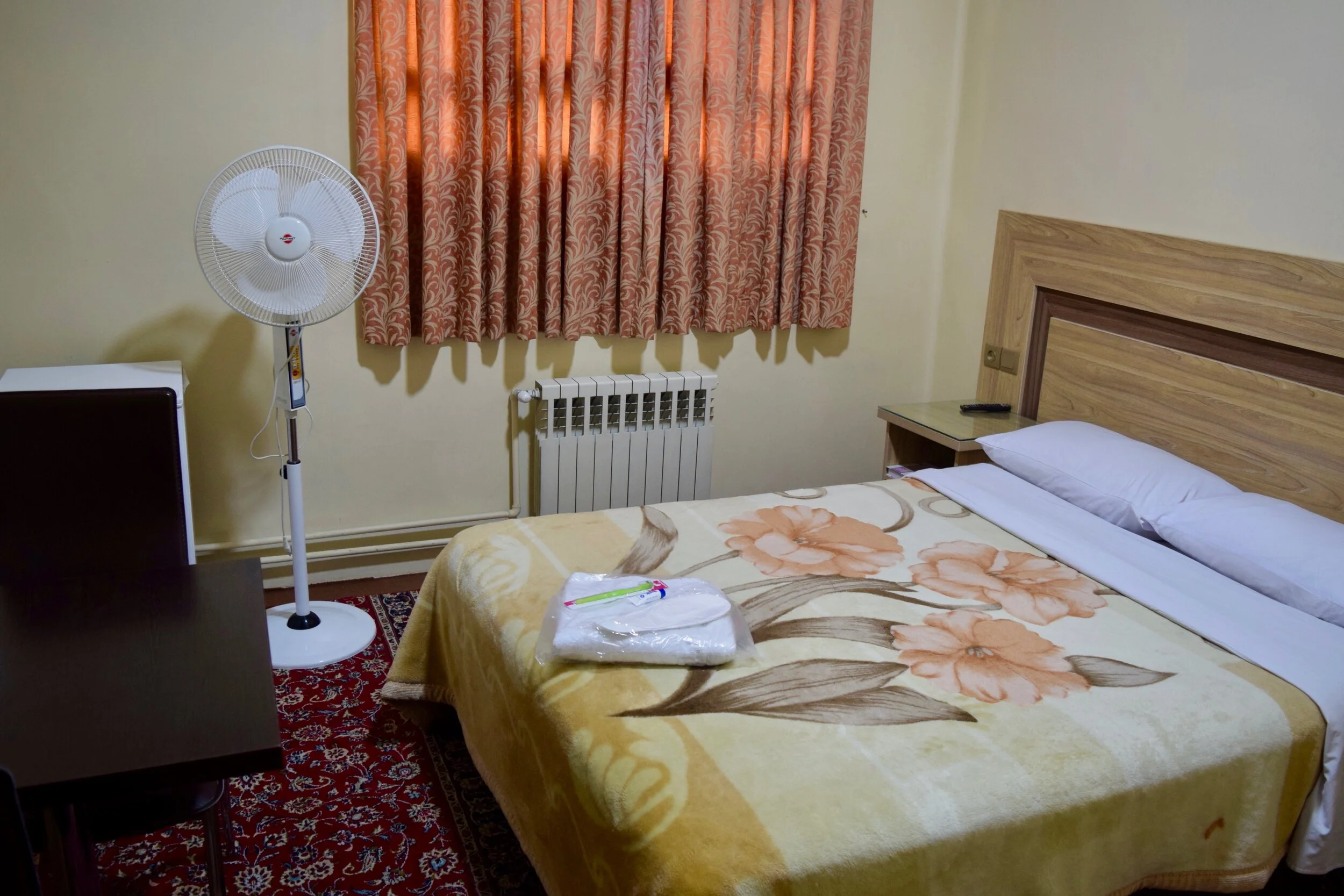
Iran Hotel
If you’d like to stay in a central location in a place that resembles a proper western hotel, Iran Hotel in Isfahan is a great option. Found in the historic Chahar Bagh Abbasi Avenue, most tourist attractions of the city can be reached by foot only in a a few minutes.
This family-run hotel has been operating since the 70s and really has the structure of what you would expect from a hotel in most Western countries, with spacious beds and toilets. Although the facilities are slightly dated, it still offers much higher standards than most accommodations in Iran!
Their latest rates are 1,176,000 rials for a single room (approx. €25) and 1,964,00 rial for a double room (approx. €43).

Traditional Banquet Hall
Just next to Naqsh-e Jahan square, this beautiful restaurant is decorated in a Qajar style with stained glass and tiles, as well as daybeds where food is served.
Although prices may be higher than in other places in Isfahan, the atmosphere is worth it. I ordered a very generous traditional dish and tea with sweets and the bill was 400,000 rials (approx. €8.5), which wasn’t bad considering the location and great service.

This article is now available as a mobile app. Go to GPSmyCity to download the app for GPS-assisted travel directions to the attractions featured in this article.


Famous for being the hottest place on Earth and its impressive rock formations, the Lut Desert is a must if you’re visiting the Kerman region.
During my 2 week trip to Iran, I stayed in a camp to enjoy the sunrise over the egg-shaped hills of the Lut Desert and explore its incredible rock formations, known as Kaluts, as well as the salt rivers that emerge from the arid landscape.
I completed my visit exploring the mysterious city of Kerman, an off the beaten track destination where not many foreign visitors stop!