
Kashan: the city of historic houses
Located in the northern Isfahan province and famous for its beautiful historical and cultural sites, Kashan is a lesser known city that cannot be missed in a trip to Iran.
After having spent a day in the chaotic capital Tehran, I started my trip across Iran by taking a bus that would bring me to Kashan, where I would explore its beautiful historic houses and the impressive bazaar. Check out what this place so rich in history has to offer!
How to get to Kashan
Kashan is located 243km south from Tehran. Check out here my 2 days visiting Tehran! The easiest way to get from Tehran to Kashan is by bus, which will take approximately 2h30m.
In Iran, you will find two options for buses: regular buses and VIP buses. The latter are more comfortable buses, usually with seats that have more space and can be reclined. They also give you some snacks, which usually includes juice, cookies and pastries. Although prices are higher for the VIP buses, the cost of transportation is so low in Iran that they’re a much-preferred option.
Bus ticket from Tehran to Kashan
Booking transport in Iran from abroad is a very difficult task, as the sanctions on Iran make it impossible to process international credit cards, such as Visa, Mastercard or Amex in the country. Since I was afraid of not being able to get bus tickets at my desired time and wanted to book in advance, I decided to contact a tour operator that could book the tickets for me from within the country.
This is how I came across with TAP Persia, a tour operator whose purpose is to bring foreign guests in Iran and make them feel at home. They offer all type of services that include guided tours and hotel, bus and flight reservations. They accept payments outside of Iran through PayPal, so they’re a great option to book your transportation. I used them for all my bus tickets as well as my flight from Shiraz back to Tehran and they’re very reliable.
If you’re looking for a VIP bus from Tehran to Kashan, they depart very frequently every 20-30m from Tehran South Terminal. Since I wanted to spend as much time as possible in Kashan, I booked the bus at 8:15 am and made it in the city around 11 am. With TAP Persia, the bus ticket had a cost of only €4.80.
After booking, they sent me my ticket via email, which was mainly a proof of purchase that needed to be exchanged at the ticket office in Tehran’s bus station. The buses were indeed quite comfortable and overall it was a very pleasant journey. When you arrive in Kashan, you will most likely need a taxi to get into your accommodation. As usual, use the local taxi app Snapp to book your taxis in Iran, as all other western taxi services won’t work there!
what to see in Kashan
I started my visit to Kashan with one of its most representative sites, the Agha Bozorg Mosque. Entrance is free of charge.
Built in the late 18th, it was constructed to hold the prayers and preaching of Mulla Mohammad Naraqi, known by his title Agha Bozorg, meaning big or great lord, which was given to him by the Shah.
The mosque is noted for the symmetrical design consisting of two large iwans: one in front of the mihrab and the other one at the entrance. It also includes a courtyard formed by a garden and a fountain, as well as two minarets with a brick dome.
Entrance to the mosque
Iwan at the entrance
Agha Bozorg mosque
Second iwan
Interior of the mosque
Entrance of the Agha Bozorg mosque
View from the arches
Building on the side
Kashan is famous for its historic houses. While some of them have been transformed into hotels and guest houses, many of them are open to the visitor. I started my visit with the Abbasian House. It has an entrance fee of 150,000 rial (approx. €4).
This historical house was built by Seed Ebrahim Tajer Kashami in 1823 and took 20 years to complete. It consists of five yards that are below the ground level. The paintings and different kinds of Islamic architectural decorations are among the salient features of this historical house.
This house has a size of about 2000 square metres. Since this building is multi-storey, the total substructure is about 7000 square metres. The whole building includes five yards for the family section, a business section, a garden, rooms for servants and the room with a pond.
The business section was used as the welcoming section for the business people and includes the mirror hall, a porch, three-dorm rooms, five-dorm rooms and other sections.
Abbasian house
Windows of the house
Detail of the decoration
Central courtyard
The Abbasian House is a symmetrical architecture design. If a hypothetical line is drawn from the middle, both sides will be completely symmetrical.
The house has winter and summer accommodation options due to the Kashani climate. According to the conditions of each season, a particular part of the house was utilised.
This building possesses the spirit of internally-oriented architecture and despite today’s modern buildings with very delicate façades, in older architecture a very simple façade was always coupled with a highly sophisticated and gorgeous interior design.
If you’re looking for a nice restaurant to eat, I had lunch at the restaurant right adjacent to the house. The restaurant was beautiful and not very expensive for the location; I only paid 300.000 rial (approx. 8€) for a mixed kebab, olives and water.
View of the central courtyard
Interior halls
Exterior view of the upper floor
View from the lower floor
I continued discovering Kashan’s heritage with a visit to the Tabatabaei House. This house was built by Seed Jasfar Tabatabaee (one of the famous handmade carpet merchants) in 1834. The entrance fee is also 150,000 rial (approx. €4).
The house is built below the ground level with an internal-oriented and symmetrical design. This house includes the family section, business section and servant’s section. It has a size of 4730 square metres and includes 40 rooms, 4 yards, 4 cellars, 3 wind towers and 2 underground water canals.
I didn't find it as impressive as the Abbasian House, but the gardens were very nice.
Courtyard
Building on the side
Tabatabaei House
Upper decoration
Ceiling
Interior
View of the upper floor
Decorated walls
One of the most beautiful parts of the house is the business room. Located in the southern part of the business section, it is a room with seven doors (this is rarely seen in other historical houses) that opens to the mirror porch. Almost all kinds of Iranian architecture have been used in this spacious and luxurious hall.
The business room was the homeowner’s business chamber. Perhaps that’s why the mirror porch is located in front of it: the mirror and plasterwork of its high ceiling are actually one of the carpet designs of Kashan and it is said that a carpet with the same design was fabricated here. The carpet design was a symbol of the homeowner’s job and commensurates with his business chamber. A vertical symmetry was also created between the ceiling and the floor.
Additionally, this place was used as a reception hall for special guests, therefore, it is the biggest and most luxurious room in the house.
The sunlight makes the hall bright and colourful by shining through side spaces, especially the coloured glass windows. The mirror work of the ceiling also produces good lighting at night thanks to the tulip-candle chandeliers.
Business room of the Tabatabaei House
Just around the corner from the historic house, I visited the Sultan Amir Ahmad Bathhouse, a traditional Iranian public bathhouse from the 16th century. It was later renovated during the Qajar era after it was damaged by an earthquake. The entrance fee is 150,000 rial (approx. €4).
The complex comprises 1000 square meters with two different parts: a dressing hall and the hot bathing hall. The dressing hall has an octagonal shape with an octagonal pool in the centre, while the hot bathing hall has four pillars which make smaller bathing rooms around the building. The interior is beautifully decorated with tile work, plasterwork and paintings.
But one of the best parts of the bathhouse is the roof, made up of multiple domes with convex glasses that provide sunlight to the bathhouse without showing the inside. Don’t forget to go up to the room to enjoy some very nice views of Kashan!
Entrance to the bathhouse
Dressing hall
Sultan Amir Ahmad Bathhouse
Hot bathing hall
Ceiling
View of Kashan from the rooftop
Domes on the rooftop
Rooftop of the Sultan Amir Ahmad Bathhouse
Near the bathhouse you will find the Borujerdi Historic House, another recommended visit. Like most sites in Kashan, the entrance fee is 150,000 rial (approx. €4).
It was built in an area of 3500 square metres by a businessman called Seyed Hassan Natanzi in the Qajar era (1859).
This unique building includes an exterior and two interior yards with exquisite, beautiful architectural decorations about hunting, portraits and myths. The internal decoration was by far my favourite from all the three houses that I visited.
Decorated walls
Entrance and courtyard
Borujerdi Historic House
Ceiling
Plasterwork in the inside
One of the best experiences in Kashan is getting lost in the winding streets while walking around the city. Although my visit took place just after Nowruz (the Persian New Year) and all touristic places were quite crowded, most of the narrow streets of Kashan were almost deserted.
During my walk, not too far from the bathhouse, I came across a beautiful mosque almost hidden behind some buildings. Although it can’t be fully appreciated from the ground, the beautiful dome can be seen from the top of some of the houses. There isn’t much inside apart from a richly decorated tomb.
Mosque in Kashan
Tomb inside the mosque
Minarets
Kashan has some other interesting houses that are worth a visit, such as the Ameri historic house, the Taj historic house or the Yasin historic house. My time in the city was quite limited, so I decided to skip the other houses and head straight to the bazaar of Kashan.
The bazaar is one of the busiest shopping areas of the city, with a total length that covers a few kilometres. The bazaar is not only a good place to go shopping, but inside you can also find multiple mosques, tombs, baths and of course the famous Aminoddole Caravanserai.
Although the caravanserai is used for commerce, some important religious ceremonies are also held in there. The chambers of this plaza have been used traditionally to trade rugs, but you can also find some antique shops and teahouses.
Bazaar of Kashan
Locals shopping in the bazaar
Aminoddole Caravanserai
Decoration in the caravanserai
Ceiling
Bazaar o Kashan
Ceiling of the bazaar
Decorated ceiling
As you keep walking inside the bazaar, another point of interest is the Mir Emad Mosque. The initial construction of the mosque started in the sixth and seventh centuries BC. The idea was supported by the precious sanctuary of the mosque made in 623 BC by a Kashani artist.
During the Mongol era in the middle of the 9th century BC, a person named Khajeh Emad al-din Shebli Shirvani built a large square at the beginning of the Old Bazaar and constructed the surrounding buildings, constructions that included a mosque, a caravanserai and a hospital. Today, only the remaining of the mosque and the square can be found.
The mosque has a unique entrance whose beautifully decorated muqarnas with watercolour paintings are exclusive in its kind. The founder’s name, as well as the year of construction, are inscribed at the entrance.
Mir Emad Mosque
If you’re wondering whether Kashan is worth a visit, I firmly believe that this gorgeous city should be included in any trip to Iran. Not only the historic houses are a must, but the bazaar is by far one of the most beautifully decorated in Iran.
I still had one more site to visit in Kashan, though. Located just outside of the city, next morning I would visit the Fin Garden of Kashan just before heading to Esfahan with a stop in the red village of Abyaneh.
Where to sleep in Kashan
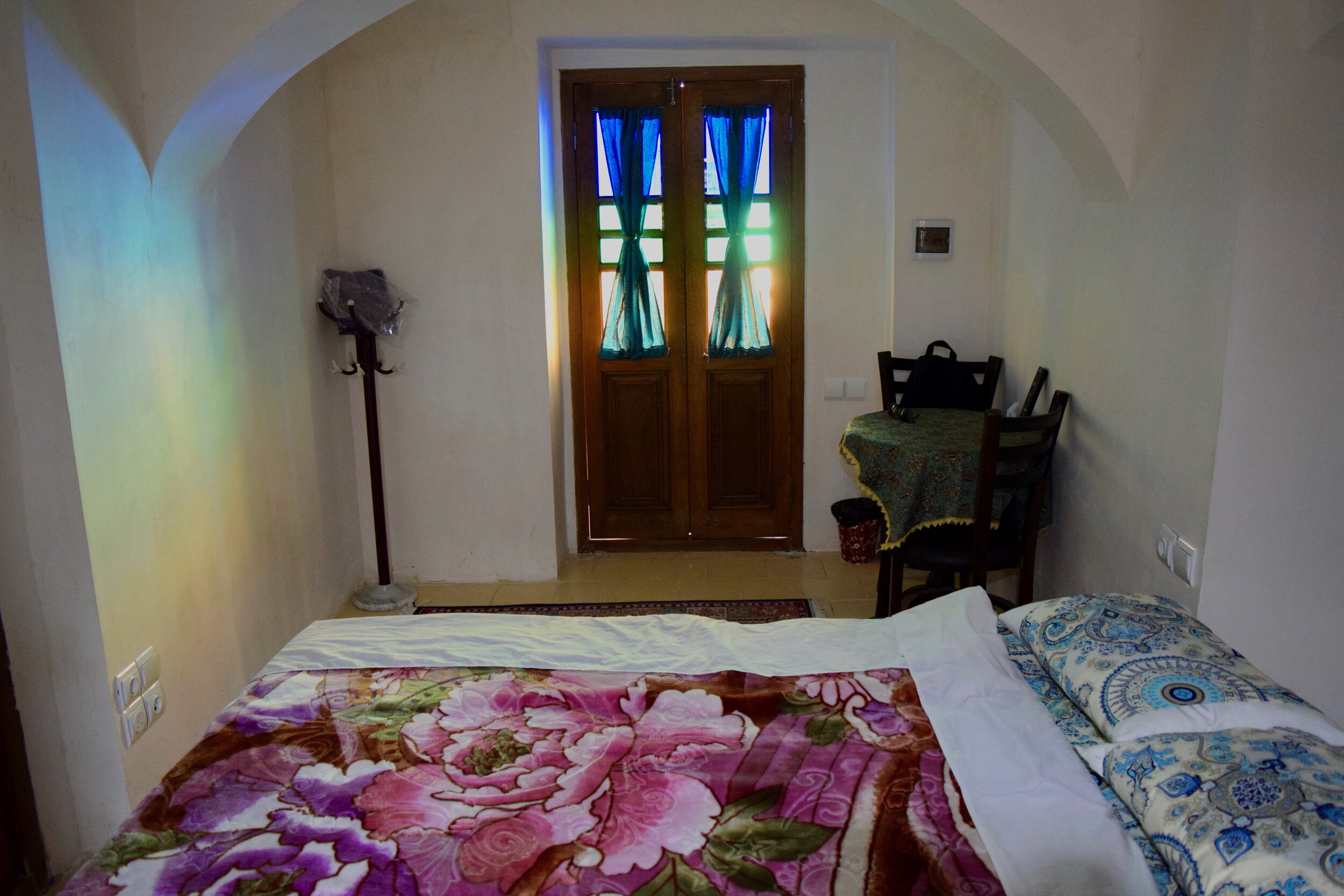
Since Kashan is known for its historic houses, I decided to stay in one of them: the Sana Historical Hostel.
Located in the city centre of Kashan, just next to the Agha Bozorg Mosque and near all the main sites, this hotel has two floors with a yard flanked by two terrace-like structures that offers great views of the yard.
The rooms are quite modest, but they are comfortable enough for a short stay in Kashan. Breakfast is included and they accept bookings and payments through their site. I paid €38 for a double room with private bathroom in high season.
All opinions are my own.


Former capital of Persia for over a hundred years during the Safavid dynasty, Isfahan is today one of the most impressive cities of modern Iran.
In its central Square, Naqsh-e Jahan, you will find one of the most outstanding open spaces in the world, comprising the main historical sites of the city and declared a UNESCO Heritage Site due to its architectural and historic significance.
During my first day in Isfahan, I explored the central area around Naqsh-e Jahan Square to discover its magnificent mosques, endless bazaar and picturesque gardens and palaces. Check out the first part of my visit to Isfahan, the highlight of Iran!