
Isfahan, 2 days in the highlight of Iran - Part II: Jameh Mosque, Ali Imam Square, Si-o-Seh Pol Bridge & Vank Cathedral
After spending an incredible first day in Isfahan visiting the impressive Naqsh-e Jahan Square, for my second day, I would venture beyond the heart of the city to visit the second UNESCO World Heritage Site in Isfahan, the striking Jameh Mosque.
I continued exploring Ali Imam Square before ending my stay in Isfahan discovering the Armenian Quarter of New Julfa and its incredible Vank Cathedral, a big contrast to the predominantly Islamic architecture of Iran!
How to get to isfahan
Naqsh-e Jahan Square
I reached Isfahan from Kashan with a private transfer organised by TAP Persia, which included a stop at the Fin Garden of Kashan and Abyaneh, a beautiful village located 87km south from Kashan. Check out my post from Kashan to Isfahan: Fin Garden & the red village of Abyaneh!
TAP Persia is a tour operator whose purpose is to bring foreign guests in Iran and make them feel at home. They offer all type of services that include guided tours and hotel, bus and flight reservations. They accept payments outside of Iran through PayPal, so they’re a great option to book your transportation. I used them for all my bus tickets as well as my flight from Shiraz back to Tehran and they’re very reliable.
day 2
I woke up early in the morning to go to the exchange bureau as I was already running out of rials. Since western credit cards don’t work in Iran and you can’t find rials in foreign exchange bureaus, I had to bring with me hundreds of euros and exchange directly in Iran in the hope that they would last until the end of the trip, as otherwise, I wouldn’t be able to withdraw more money! I always recommend bringing with you much more money than you expect to spend, just in case there is an emergency.
After getting some money I took a taxi directly to Jameh Mosque. My driver didn’t speak any English at all, but I still managed to get myself understood. The ride was only 100,000 rial (approx. €2).
My driver dropped me just at one of the entrances of the bazaar, located almost at the other end of the entrance to the Grand Bazaar in Naqsh-e Jahan Square. It took me quite a while to find the main entrance, as the bazaar is quite chaotic and there weren’t many sites. With the help of Google Maps I made it to the entrance and paid the 200,000 rials (approx. €4) entrance fee, like in most historical sights in the city.
Jameh Mosque was built during the Umayyad dynasty as a congregational mosque that was expanded and reformed from 771 when the construction started until the end fo the 20th century. Showcasing the artistic and religious styles of over 9 centuries, the mosque is the second UNESCO World Heritage Site that you can find in Isfahan and the biggest mosque in Iran, with an area covering over 20,000 sq metres.
Entrance to Jameh Mosque
Iwan
Religious writings with geometric shapes
Jameh Mosque
The history of Jameh Mosque is deeply intertwined with Isfahan’s Islamic history of architecture and urban planning. Actually, before Islam, there was no great city with this name. Based on historical documents and evidence, Isfahan consisted of several large and small villages which due to the well-watered river and the fertile lands surrounding it had the capacity to be used as a resort town. One of these locations was a village called Yavan at the centre of this area where the initial Jameh Mosque was built.
Since a long time ago, canals were dug in western parts of the region so that water could become ready for utilisation on its arrival to the Isfahan region. Interestingly, one of these canals passed through the spot where the primary Jameh Mosque was constructed, so the stream of water was used in the mosque courtyard for a long period of time, but nowadays part of the mosque yard area has totally covered up this stream.
Under the Seljuk Empire, the Jameh Mosque was transformed from a hypostyle building supported by columns into one with four iwans and a domed sanctuary that we see today. To emphasise the qibla, or direction of prayer, builders made the south iwan wider, and hence taller.
It was also the Seljugs who constructed the north iwan with its two brick domed chamber that made the mosque famous. The choice of architecture is clearly an enormous contrast to other Islamic buildings in Isfahan, it actually gives the impression that you’re inside a Gothic church rather than a mosque!
Arched chamber
Dome
Arches in the north iwan
Smaller domes
Brick-domed chamber
The construction of the northern iwan was possibly the last phase of fundamental alterations performed during the Seljuqs era. Nothing remained out of its main facade after 1934 AD and at present, most of it is considered a contemporary reconstruction.
On the external facade of the northern iwan, you will find the impressive Uljayto Mihrab, one of the most exquisite monuments of the Ilkhanid era built during the reign of Khodabanda Iljeitu, hence the name. The mihrab, with its double false arches, is a fine example of stucco mihrabs of Iranian mosques containing several inscriptions in Thuluth script, one inscription in Kufic script as well as delicate ornaments made of florals and geometrical patterns.
View of Jameh Mosque
Local woman in Jameh Mosque
Uljayto Mihrab
Islamic art
Dome in the south iwan
Just south of Masjed-e Jameh mosque and the bazaar, almost by accident, I appeared in Imam Ali Square. Once the hub of Isfahan during the Seljuk dynasty in the 11th century, this immense square lost importance after the Safavids moved the main centre to Naqsh-e Jahan Square.
You can find multiple monuments around it in addition to the bazaar and Masjed-e Jameh, such as Harun Vilayat Mosque and its big painting of the leaders of Iran, or Haroonieh Mosque and the beautiful painting of human figures, something uncommon in Islam.
Imam Ali Square
Fountains in the Imam Ali Square
Harun Vilayat Mosque
One of the many domes near Imam Ali Square
Paintings at the entrance of Haroonieh Mosque
Tomb in Haroonieh Mosque
After wandering around the winding streets around Ali Square, I headed north-west and walked for about 15 minutes until I reached the Soltan Bakht Agha Mausoleum, located 15 minutes walking north-west from the square.
This historical mausoleum holds the tomb of Soltan Bakht Agha, Shah Abu Essahq’s niece. When her uncle was murdered by the Mozaffarids, she married a Mozaffarid to influence and divide the court, helped by her brother-in-law Jalaleddin.
When her husband discovered her plans, she ordered to killed her. When her brother-in-law Jalaleddin captured Isfahan, he built a magnificent mausoleum for her tomb.
Soltan Bakht Agha Mausoleum
It was past lunch time and my guide was recommending a restaurant located inside the bazaar, however, I had to give up after asking and walking up up and down the bazaar multiple times. I ended up going to the main avenue and getting lunch at Shahab Restaurant, which actually was a good choice. I ordered a very decent kebab with rice and water for only 100,000 rial (approx. €2), just over two euros!
It was still early so I decided to walk for about 20 minutes back to Naqsh-e Jahan Square and stayed for a couple of hours in my room in the Iran Hotel to get some rest. I still had some things to visit on the other side of the river, so I freshened up and started my afternoon visit with Chahar Bagh Theological School.
Built between the 17th and 18th centuries during the reign of Soltan Hossein, it was used as a theological school for those interested in studying religion. The monumental portal, decorated with gold and silver tile-work, gives access that leads to a beautiful domed octagonal vestibule. The complex only opens during Nowruz, so I was extremely lucky!
Chahar Bagh Theological School
Internal decoration
Tile-work dome
Internal courtyard
Internal rooms
Nowruz decoration
Traditional Iranian tile-work
One of the most iconic sights of Isfahan is Si-o-Seh Pol Bridge, ‘the bridge of thirty-three arches’ in Persian. Built in the 17th century both as a river and a dam, it has a length of 297m with two superimposed rows of 33 arches where its name comes from.
The bridge is one of the 11 constructions over the Zayanderud River. This river that used to flow for over 400km, passing by Isfahan, but now runs dry due to the water extraction. Only in very rare occasions does the water flow again in Isfahan.
Si-o-Seh Pol Bridge
I crossed to the other side of the ‘river’ and starting heading to the Armenian quarter. It got pretty hot after crossing the bridge, and although the walk wasn’t that long, I kinda regretted not getting a taxi.
The Armenian Quarter, known as New Julfa, was established in the 17th century when over 150,000 Armenians moved there from Julfa, in today's Azerbaijan. It is believed that they moved to Iran running away from the Ottoman persecution. The entrance fee to the complex, including the cathedral and the museum, is 300,000 rial (approx. €6.5), higher than most other monuments in Isfahan.
The most famous building is Vank Cathedral. The cathedral is located at the Big Square town in Julia. This cathedral is considered as the principal church of Armenians and the domicile of the Diocesan Council, also the centre of religious, cultural and social activities for over 400 years.
Square in New Julfa
Vank Cathedral
Entrance, towers and dome of Vank Cathedral
The architectural style of the church is influenced by Armenian, European and Iranian features and arts. This construction is a masterpiece of merging three architectural styles. The construction of the church is made of sun-dried brick and the vault of it is two-layered with the facade made of brick.
The entire inner walls and angles of the church are covered with plaster painted with Bible illustrations of some episodes from the Old and New Testaments. The illustrations are work of famous painters of the time, painting in oil paint and decorated with gold leaf.
The lower parts of the church walls are covered with colourful and illuminated tiles inspired from natural and geometrical shapes and figures, which decorate the plinth of the church.
Depiction of Heaven, Earth & Hell
Internal decoration
Decorated ceiling
Dome

Religious paintings
Included in your entrance is the Armenian Genocide Museum located right next to the cathedral. The exhibition contains the 1606 edict of Shah Abbas I establishing New Julfa, old costumes, tapestries and ethnological displays portraying the Armenian culture and religion.
The museum also contains an extensive displays of photographs and documents about the 1915 Armenian Genocide in Turkey, when the then Government of Turkey decided to annihilate the entire Armenian population of the Western Armenia, which was then under Turkish rule. This decision was implemented through government planning by military and para-military forces organised for this very purpose.
The number of the victims of the Armenian Genocide is estimated to one and a half million. Moreover, almost the same number of Armenian inhabitants were deported from their historical homeland and found refuge in neighbouring countries such as Lebanon, Syria and Iran. The belongings and property of Armenians were confiscated. Armenians all over the world commemorate the Genocide and remember its victims on the 24th of April every year.
Armenian Genocide Memorial
It was getting dark by the time that I left the Armenian Quarter, so I got a taxi back to the Iran Hotel to start packing my things. After a last night walk around Naqsh-e Jahan Square and Si-o-Seh Pol Bridge, where I could enjoy a very good display of music and lights for Nowruz, it was time to say goodbye to Isfahan, one of the highlights of Iran!
Next day, I would continue my two-week adventure in Iran by taking a private transfer from Isfahan to Yazd, visiting on the way the abandoned mud-town of Kharanaq, the sacred Zoroastrian village of Chak Chak and the impressive Narin castle!
All opinions are my own.
Where to sleep in Isfahan
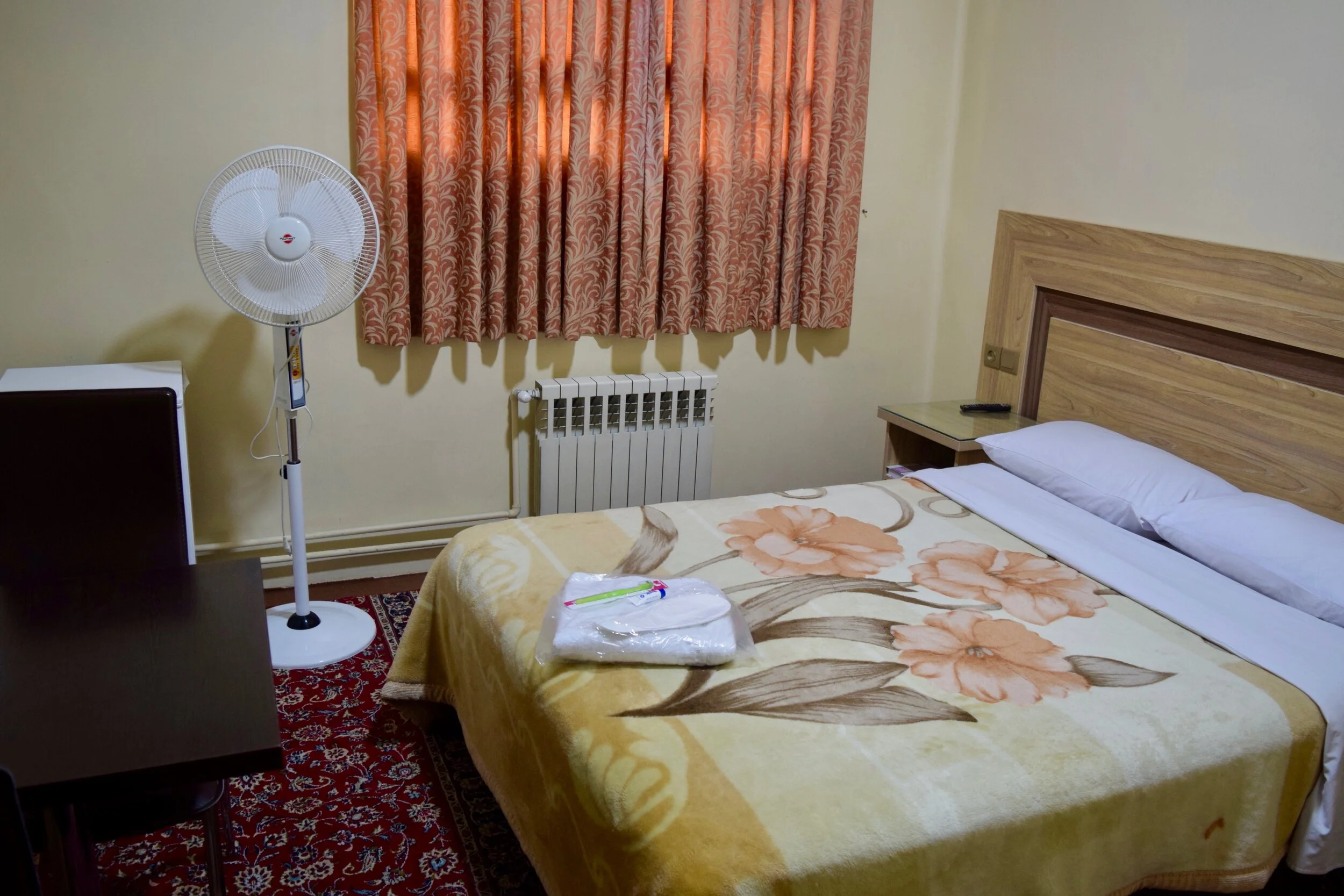
Iran Hotel
If you’d like to stay in a central location in a place that resembles a proper western hotel, Iran Hotel in Isfahan is a great option. Found in the historic Chahar Bagh Abbasi Avenue, most tourist attractions of the city can be reached by foot only in a a few minutes.
This family-run hotel has been operating since the 70s and really has the structure of what you would expect from a hotel in most Western countries, with spacious beds and toilets. Although the facilities are slightly dated, it still offers much higher standards than most accommodations in Iran!
Their latest rates are 1,176,000 rials for a single room (approx. €25) and 1,964,00 rial for a double room (approx. €43).

This article is now available as a mobile app. Go to GPSmyCity to download the app for GPS-assisted travel directions to the attractions featured in this article.


Famous for being the hottest place on Earth and its impressive rock formations, the Lut Desert is a must if you’re visiting the Kerman region.
During my 2 week trip to Iran, I stayed in a camp to enjoy the sunrise over the egg-shaped hills of the Lut Desert and explore its incredible rock formations, known as Kaluts, as well as the salt rivers that emerge from the arid landscape.
I completed my visit exploring the mysterious city of Kerman, an off the beaten track destination where not many foreign visitors stop!