
2 days in Tehran, part I: the old town
The Islamic Republic of Iran, historically known as Persia, is one of the most captivating countries that I’ve ever visited. A very unpopular touristic destination due to its bad relations with most Western countries and its very strict Islamic law, the truth is that this Middle Eastern country has the most welcoming people that I’ve ever encountered during my travels.
I started my two week visit to Iran from its capital, Teheran, a chaotic metropolis home to over 8 million people where the old history and modern architecture live together in perfect harmony. During my first day I visited the old town to discover its busy bazaar, the National Museum of Iran and the gorgeous Golestan Palace. Discover with me the fascinating capital of Iran!
How to get to Tehran
Tehran is the main gateway for international visitors into Iran. The Imam Khomeini International Airport offers connections with most European cities, so you will be able to find cheaper options than flying to Esfahan, Shiraz or Tabriz.
You will need a visa to enter Iran if you’re from most Western countries. The requirements vary greatly, so I’d personally recommend to double check your nationality from this link here.
Visitors from the European Union like myself can get a visa on arrival. These can only be obtained from the International airports, and all you'll need to do is:
A confirmed return ticket within 30-days,
A photo to be attached to the application form,
An invitation letter or hotel reservation for your stay,
Travel insurance that specifically covers Iran. They didn’t ask me for this during my visit.
Azadi Tower
Most visas on arrival have a cost of €75, unless you're visiting from Australia: visas for this nationality have a cost of €145. Getting a visa on arrival couldn’t have been easier in my case, when I arrived at the airport and before the immigration controls I just had to fill out some papers, pay the fee and wait for about one hour before I got back my passport .
A big exception for the visa in arrival are visitors from the US, the UK or Canada. Visitors from these countries can’t actually visit the country on their own: they will need to book an organised tour and have a guide always with them. Visas need to be requested in advance at their closest Iranian embassy.
Once you’ve sorted out your visa and passed through immigration, the most convenient way to reach Tehran is the taxi. You can get them just outside the terminal, or if you’ve managed to buy some mobile data, you can download Snapp, the local and very recommended version for Uber. The journey will take about 20 minutes, depending on where in the city you’re heading to. Prices should be around 12-15 euros.
History of Iran & Tehran
Iran has one of the richest and most interesting historic past in the world. Known as Persia until the mid-20th century, the country was already the largest empire in the world back in 550 BC during the Achaemenid Empire, with their capital city in Persis (Persepolis).
They were succeeded by the Seleucid, Parthian and Sasanian Empires, who kept Iran at the top of the world's power for over a millennium. The biggest threat of the Persian Empire was the Roman Empire, succeeded by the Byzantine Empire.
In spite of the multiple conquests by Greeks, Arabs, Turks and Mongols, Iran has always managed to preserve their national identity throughout history. But the Muslim conquest of Persia in 633 was the biggest turning point for this country, as the Islamic faith replaced Zoroastrianism.
Iran was reunified in 1501 as an independent state under the rule of the Safavid dynasty with Shia Islam as the official religion. The country was run as a monarchy until the 1979 Iranian Revolution, a series of events that overthrow the Shah of Iran and replaced him with an Islamic republic ruled by the Grand Ayatollah Ruhollah Khomeini.
Skyline of Tehran
Nowadays, Iran is still a very strict Islamic Republic, where some of the laws include the prohibition of any alcohol products, the mandatory use for women of a veil covering their heads, including tourists or death penalty for homosexual acts. The country is also well known for its record violating human rights.
The current capital, Tehran, was only established in 1907. The city was almost rebuilt from scratch by Reza Shah on the 20s and 30s, demolishing multiple old buildings that were replaced by constructions influenced by classical Iranian architecture.
Compared to the rest of the country, Tehran is a very modern metropolis that resembles any modern Western capital. By visiting Tehran, you couldn’t get an idea of what the rest of the country has to offer. Although it does contain some historical sites of interest, the capital is a chaotic mass of concrete compared to the breathtaking cities of Esfahan or Shiraz.
Tehran, however, is an essential part of any trip to Iran, a country of contrasts that never stops surprising you!
what to see in Tehran: the Old Town
Teheran is clearly divided in the old town, which covers all the area around Golestan Palace, and the new city, with modern architecture that is scattered all over the city. I would return to Tehran at the very end of my trip to fly back home, so for the first day I decided to start from the beginning and first visit the older area of the city.
My hostel was located only a few meters from Imam Khomeini Square, so that was my first encounter with the city. The square was built in 1867 and was originally named Toopkhaneh, however, after the Iranian Revolution it was renamed Imam Khomeini Square in honour of the founder of the modern Islamic Republic.
I was expecting a big, open square, so I was a bit disappointed when I got there and saw that the square works more like a roundabout surrounded by traffic. It actually took me quite a bit to manage to cross to the middle as traffic and drivers in Iran are absolutely mad!
The square doesn’t offer much apart from the beautiful fountains in the middle. During my visit it was decorated for Nowruz, the Iranian New Year's celebration, which normally takes place on March 20.
Sign of the square
Fountains in the square
Imam Khomeini Square
Monument in the middle of the square
Nowruz decoration
As I continued walking through Imam Khomeini Street, on the right hand side I reached the Mashq Square complex.
It is located on an area originally constructed as a garrison in the northern part of Tehran and out of the city limits. However, on the verge of the 20th century, it was transformed into a place to establish the office, services and cultural buildings in the new city centre.
The buildings established today in this urban complex highlight a period of historical changes in architecture in Iran, during which the ancient architectural traditions are transformed into the European Neoclassical style combined with the Iranian Neoclassical style.
Most of the buildings of this complex are harmonic combinations of the European and the Iranian ancient architectures, and I was lucky enough to visit when it was almost deserted. It actually reminded me a lot of the beautiful city centre of Beirut without any tourist around.
Mashq Square complex
The complex is accessed through the National Garden portal, or ‘Bagh-e Melli’. The edifice was initially built for the purpose of establishing a gate for entering the Mash Square, which was a garrison and was named as Mashq Square portal. But the simultaneity of the first years of the portal with the construction of a public garden inside the Mashq Square caused people to give it it Bagh melli or National Garden portal.
The architecture is inspired by the ancient gateways of Tehran city, specifically Darvaza Dowlat (Dowlat gateway), which was located at the southwest of the Old Toupkahneh.
The initial portal consisted of three entrance gateways. At the top of the middle gateway there was a room that was the lookout place.
The tile epigraphs attached to the portal contain eulogies in praise of Reza Khan Sardar Sepah, who was the army commander and client of this building.
Bagh-e Melli portal
Malek National Library & Museum
Building near the museum
In the middle of the complex is located the Ministry of Foreign Affairs. Completed in 1936, it is the most expanded governmental building in Iran.
The most outstanding part of the building is the centra part, which leads from both sides of the street to a magnificent and high balcony with a wide stairway. This balcony leads to the big hall at the building’s entrance, and it has been the place of holding military and formal ceremonies.
The architectural style of the building is Neoclassical but the ornaments of the exterior façade are a combination of the Ancient Iranian Art and the Iranian Art in the Islamic era. The stone-made towering pillars with Achaemenid capitals emphasise the historicity of this architecture, along with the tile and mosaic work of the Islamic era.
Building in the Mashq Square complex
Details of the building
Ministry of Foreign Affairs
Achaemenid capitals
Ornaments on the façade
At the other end fo the complex you will find the Cossacks Quarters edifice, or ‘Qazaq Khaneh’. This is the most outstanding and ancient building located in the Mashq Square complex. Qazaq Khaneh building is formed of two parts constructed during the Qajar and Pahlavi eras.
The Qajar’s era part of the building is in a neoclassical and modernist construction, combining the Iranian and European Architectural styles. The building faces toward a vast square that has previously held military ceremonies. The various balconies are located in the same shape at the front and back facades. The Qajar part o the building is also formed of three floors consisting of a middle part and two wings on both sides.
Tehran is a city surrounded by mountains, and usually these can be seen from most part of the city. However, the big pollution that covers Tehran makes it sometimes difficult to actually see the mountains. During my visit, the smog only let me see the shapes in the distance.
Mashq Square with mountains on the background
Qazaq Khaneh
Closer view of the building
Just five minutes away from the Mashq Square Complex I got my next destination, the National Museum of Iran. I reached it through the Moallem Park, a small square with trees and a fountain where families were hanging around.
The National Museum of Iran is formed of two different buildings and collections: the Museum of Ancient Iran and the Museum of the Islamic Era. During my visit, there was a third additional exhibitions with objects brought from the Louvre in Paris.
The collections includes pottery vessels, metal objects, rare book and coins, as well as textiles. The building was designed by French architects at the beginning of the 20th century. The Museum of the Islamic Era was constructer later using white travertine on the gardens just next to the Museum of Ancient Iran.
The area around the museum was full of food tracks with some delicious kebabs and other options for very low prices. I came back here at dusk and got a bread filled with delicious meat for only two euros, drink included.
National Museum of Iran from the Moallem Park
Museum of the Islamic Era
15 minutes north by foot from the Golestan Palace I highly recommend a visit to the Treasury of National Jewels, a museum that stores and exhibits all the national jewels of Iran in one of the most famous collections of diamonds and other jewels.
The opening times are very limited, only from 2pm to 5pm Saturday through Tuesday, with the last tickets being sold 30 minutes before, so plan to be around the area in between those times. As I previously mentioned, my visit took place just after Nowruz, the Persian New Year, and the entire country gets holidays for a couple of weeks. As the busiest period of the year, I was expecting some queues, and I had to wait for about 30 minutes in the heat but it wasn’t that bad.
The entrance fee is 200,000 rials (approx. €5.5) and includes a guided tour around all the main highlights of the collection. After waiting outside the building, which is actually a bank, you’ll need to get a number and wait in a room until you’re called to buy your ticket. You then have a wait a few moments to be assigned a group and a guide. There are many groups visiting at the same time, so you will have to wait a little bit to see the different items and your time is quite limited as there will be another group already waiting behind you.
I was unlucky enough to be put in a group with a guide in Persian. I asked to be moved to an English group but there wasn’t any around and with all the confusion of the crowds I continued with this guide. I couldn’t really understand the explanations, but the jewels were worth it. A big highlight that day.
Unfortunately, photography is strictly prohibited. You will need to leave all your items, including wallet, phone, bags and anything that you’re carrying at the locker, then pick it up at the end of your visit.
I headed back to the national Museum of Iran and then crossed the City Park, known in Persian as ‘Park-e Shahr’. The park is quite big and has some beautiful founts and monuments, so I recommend crossing it through when heading south. During my visit I mainly found families and people practising sport, with many of them using the free fitness equipment that you can find int he park.
City Park
Monument in the park
Mosque
At the end of the park and after following Naser Khosrow street, which has some very interesting buildings and a beautiful square, I arrived at the Grand Bazaar of Tehran. Split into several corridors over 10 kilometers in length, each area specialises in different types of goods and products.
The origins of the bazaar are unknown, but after the Muslim conquest of Iran in 633 the first travellers reported the growth of commerce in the area that now occupies the bazaar. The place is perfect for some souvenir purchases, but be ready to haggle!
The main entrance to the bazaar is surrounded by restaurants and food trucks, so I stopped here for some food. I soon realised that all menus and signs were only in Farsi, so I really had no clue what to order. Most of the restaurants in this area offer very similar food, so I entered in a small kebab restaurant that wasn't too crowded and ordered a mixed kebab in a bread for only 3 euros including a drink.
Don't forget to visit the Shah Mosque, located in the middle of the maze formed by the bazaar. The mosque was ordered by Fath-Ali Shah Qajar of Persia. When it was completed, it was considered the most significant monument of Teheran. The two current minarets were added during the reign of Naser al-Din Sha Qajar.
Building in Naser Khosrow street
Grand Bazaar
Square outside the bazaar
Mosque inside the bazaar
Tile work
Shah Mosque
The most visited and representative monument in Tehran is the famous Golestan Palace, the former royal complex of the Qajar dynasty.
This heritage site consists of a group of royal buildings that were surrounded by the walls of a citadel. It includes gardens, royal buildings and art collections. The ticketing system is quite complex, as you can pay for all the different parts of the palace separately. You can basically get add-ons and pay according with what you want to visit.
If you decide to visit all of them, the entrance fee will be around 1.000.000 rial (approx. €27). Considering that Iran has pretty low prices, this is a very high amount of money, so I decided to visit only the courtyard and the Main Hall, with a price of 150,000 rials each (approx. €4).
It was here that I learnt that Iranians don’t respects the queue at all. Buying tickets for the palace was an absolute chaos as everyone kept skipping the queue and screaming to get the attention of the cashier. If you don’t speak Farsi, it will be even harder. I got used and even good at it at the end of the trip, but this was a big culture shock!
Entrance to Golestan Palace
Tile work
View of the palace
I started my visit with the interior, as there was a small queue to get in. It didn’t take to long to get in, but the interior was completely overcrowded. The first room as you enter is the Mirror Hall, a relatively small hall famous for its extraordinary mirror work. Its constructions was started in 1870 AD, simultaneous with this of Levee hall, and was completed in 1873 AD.
This hall was designed by Haj Abdoul Hosein Memar bashi. At the beginning of the process of transfer of objects and artworks from the old museum in the new one, this hall was devoted to the peacocks throne and the Kiani (royal) Crown.
Ceiling
Top of the stairway
Mirror Hall
The other point of interest in the interior is the Reception Hall, or ‘Talar Salam’.
After the Iranian’s famous jewelled peacock throne was moved to the Royal Jewels collection at the Central Bank, this hall was designated to hold special receptions in the presence of the king, hence the name Talar Salam. Tourists and envoys from European courts were received in the Arg during the reign of Naser al-Din Shah, spoke of this outstanding hall comparing it to its European counterparts.
This hall has exquisite mirror works. The ceiling and walls are decorated with plaster holding. The floors are covered with tiles. During the reign of Naser al-Din Shah, this hall was used to exhibit Iranian and European paintings inside glass cases. These jewels are now housed in the Royal Jewels Museum of the Central Bank.
Renown is also the Brilliant Palace, or ‘Kakh-e Berlin’. The name apparently comes due to numerous mirror or perhaps because the fountain and floor bed and chandeliers presented by Russian Emperor Alexander I to the San.
Reception Hall
Ceiling
Room in the palace
Brilliant Palace
The gardens of the Golestan Palace are quite extensive, all surrounded by the different rooms and areas that can be visited with a separate ticket. I didn’t enter any other room, so I spent the rest of the evening strolling around the gardens. The most famous view is the facade of the Reception Hall.
But the most beautiful building is the Edifice of the Sun, or 'Shams ol Emareh'. This building was commissioned by Nasser ed Din Shah, as he wanted to have panoramic views of the city of Tehran. The building has two identical towers with an exterior that has multiple arches and a very elaborate tile work and ornate windows. The two towers are actually a small version of the Safavid palace of Ali Qapu in Isfahan.
Tile work on the walls
Decorated walls
Golestan Palace
Edifice of the Sun
Decoration on the wall
It was getting late and most monuments were starting to close for the day, so I walked back to my hostel through Pamenar street. On the way, I stopped at a hidden gallery formed by arches that was completely hidden from the main street. Don’t be afraid to get in!
Just outside of the gallery you will come into view with the Ayatollah Shahabadi Mosque, decorated with beautiful tile work.
Construction near Pamenar street
Ayatollah Shahabadi Mosque
Tile work
I would’ve loved to have an additional day in Tehran to continue visiting the old town and all the surrounding areas. I would come back to Tehran on the very last day of my trip before flying back home, but I would visit the new city instead.
For the second day of my trip, I would start my journey by bus around Iran. My first stop was Kashan, the city of historic houses. You won’t believe the beautiful constructions that you will find in this unique destination!
Where to…
Sleep in Tehran
Booking accommodation in Iran is not an easy task. Many Iranian businesses cannot trade with international countries due to the multiple sanctions on Iran, so booking or paying for a room online can be more complicated than it should.
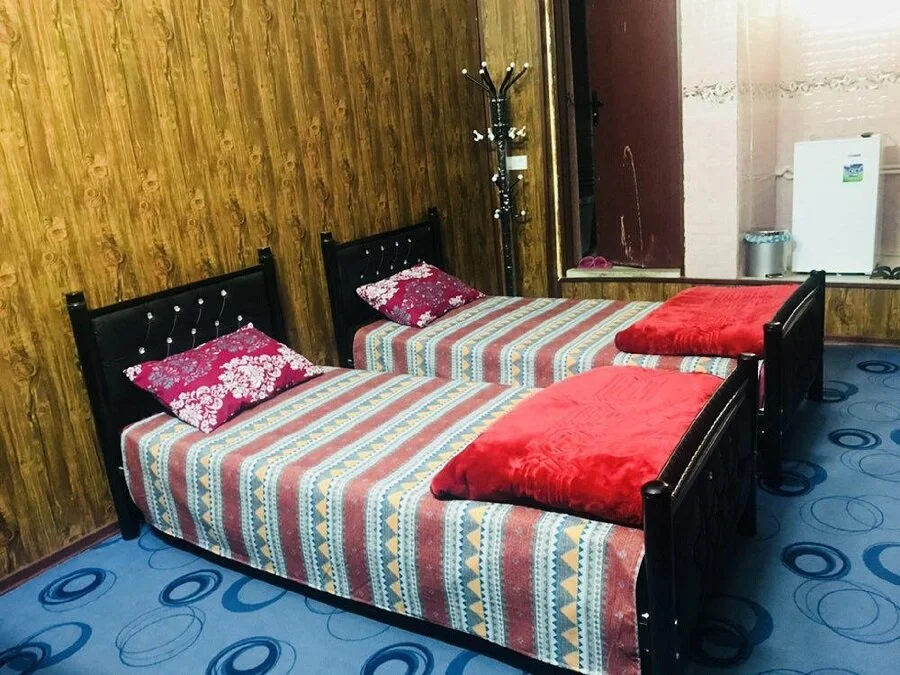
For my stay in Tehran I slept at the Seven Hostels. Bookings can be made and paid for directly from their site, and the hostel is one of the few in Iran that offers private bathrooms and showers in all rooms and even dorms. The facilities are quite modest, but the rooms have been equipped with air con and TVs.
Staff were very helpful and the location was perfect, just about 10m walk from Imam Khomeini. A private double room costs around €25. A very recommended choice!
All opinions are my own.


Famous for being the hottest place on Earth and its impressive rock formations, the Lut Desert is a must if you’re visiting the Kerman region.
During my 2 week trip to Iran, I stayed in a camp to enjoy the sunrise over the egg-shaped hills of the Lut Desert and explore its incredible rock formations, known as Kaluts, as well as the salt rivers that emerge from the arid landscape.
I completed my visit exploring the mysterious city of Kerman, an off the beaten track destination where not many foreign visitors stop!