
The best of Kyiv: 3 day itinerary
Note: this visit took place in 2019 prior to the Russian invasion of Ukraine in 2022. The information provided in this post was accurate at the time of the visit and should not be taken as advice while the current war is ongoing.
Kyiv, the capital of Ukraine, is one of the few cities in Western Europe that remains unknown to tourists. Although more and more visitors are flocking to Ukraine to visit Chernobyl, the site of the biggest nuclear disaster in history, the city Kyiv also deserves a short visit to discover all it has to offer.
During my visit, I spent 3 fascinating days in Kyiv, discovering its beautiful monasteries, memorials and parks in a perfect gateaway in Western Europe. Check out my 3 day itinerary in the surprising city of Kyiv!
How to visit Kyiv
I spent a total of 3 days in Kyiv, the perfect a mount of time to see the main highlights of the city. During my stay, I followed the itinerary below:
I arrived in Kyiv from Lviv, a beautiful city in western Ukraine. I decided to travel by train, leaving at 06:02 am and making it to Kyiv by 11:17 am. The journey took just over 5 hours and had a cost of 325 UAH (approx. €12) one way.
There are departures later during the day or even at night, but this time was the most convenient to have almost the full day in Kyiv without having to wake up at an extremely early time. You can check schedules and buy tickets online at the official Ukrzaliznytsia (Ukrainian Railways) website.
History of Kyiv
Kyiv, also known as Kiev, is the capital of Ukraine with almost 3 million inhabitants. Its name comes from Kyi, one of the founders of the city more than 1500 years ago. The name has been a centre of controversy in the recent years; known for years in western countries by its Russian name; Kiev, the local name in the Ukrainian language is Kyiv. This FORM is being increasingly used by most countries nowadays, and Ukrainians don’t really like it when the Russian name is used.
During the 10th and 12th centuries, the city became the cradle of the modern Slavic civilisation. The city belonged to different empires for over 400 years, including Lithuania and Poland, until in 1667 the city was given to Russia. Kyiv didn't play a big part within the Russian Empire, and an Ukrainian nationalism starting growing against the Russification of the country.
Kyiv
This changed in the 19th century with Russia's industrial revolution, when Kyiv became a significant centre of commerce. In 1921, Kyiv became part of the Ukrainian SSR and although the capital was moved to Kharkiv, Kyiv underwent a big restoration of its economic and cultural life.
The city was almost destroyed when the Nazis took Kiev in 1941 during World War II until it was recovered by the Soviets in 1943. The city continued growing for the next 50 years, but suffered a big recession after the fall of the USSR in 1991 and Ukraine's independence.
Kyiv is the main political centre of the country, and as such, has seen multiple revolutions that have changed the recent history of Ukraine, including the Orange Revolution in 2004 when half a million people went to the streets to protest against the election of Viktor Yanukovych.
The Euromaidan revolution in 2013 also saw millions of people on the streets and multiple fatalities when President Yanukovich decided to suspend the signing of the EU Association Agreement in a pro-Russian move. The protests ended on February 23rd, 2014 when Yanukovich resigned and fled the country to Russia.
Ukraine finally signed the Associated Agreement with the EU in 2017, in the hopes to improve its economical and political situation and align with the main European powers. In spite of all the protests that filled the media in the recent years, today Kyiv is a modern and safe city that resembles any other European capital, in spite of its Soviet remanences, which makes it even more interesting. A city full of history and incredible sites that you cannot miss!
Day 1
After leaving the train station and checking in at my rented apartment, I started my visit at Maidan Nezalezhnosti, or Independence Square, one of the most representative open spaces in Kyiv,
Independence Square is famous for being the place where multiple political rallies and demonstrations have taken place in the last years, such as the famous Orange Revolution in 2004 or the Euromaidan in 2013-14.
During my third day in Kyiv, I decided to take a free walking tour around the square to learn more about the fascinating but entangled Euromaidan, where my tour guide himself participated!
The square is crown by the Independence Monument, a victory column that commemorates the Independence of Ukraine. With a height of 61m, it was built in 2001 to commemorate the 10th anniversary of the independence of Ukraine.
Me at Independence Squarespace
Independence Monument
Monument to Taras Shevchenko
Independence Square
Statue near the Independence Monument
View of the square from the monument
I would spend the rest of the day visiting the monasteries and beautiful churches located and what today is known as ancient Kyiv, the area where the city originated. One of the most impressive constructions is the St. Michael’s Golden-Domed Monastery, one of the largest in ancient Kyiv. Entrance is free of charge.
Originally built in the Middle Ages by Sviatopolk II Iziaslavych, the monastery comprises the Cathedral itself, the refectory of St. John the Divine, built in 1713, the Economic Gates, constructed in 1760, and the monastery’s bell tower, which was added circa 1716-1719.
The exterior of the structure was rebuilt in the Ukrainian Baroque style in the 18th century while the interior remained in its original Byzantine style. The original cathedral was demolished by the Soviet authorities in the 1930s, but was reconstructed and opened in 1999 following the Ukrainian independence in 1991.
St. Michael’s Golden-Domed Monastery
Me at the monastery
View from the entrance
Church of the monastery
St. Michael’s Golden-Domed Monastery
On top of a hill overlooking the Podil neighbourhood, you will find St. Andrew's Church. Built between 1747 and 1754 in a Baroque style, the building was designed by the famous Italian architect Bartolomeo Rastrelli.
It consists of a single dome with five decorative spires. The façade is decorated with Corinthian columns, while the windows and doors contain beautiful ornamental details.
Due to its peculiar location on top of a hill, there are some concerns about the future o the church, as its foundations have started to shift and may collapse. During my visit, the church was closed with renovations, but I could still enjoy the amazing views of Kyiv from its base.
St. Andrew's Church
Closer view of the church
View of Kyiv from the church
Me at St. Andrew's Church
Walking down Volodymyrs'kyi Passage you will find St. Sophia’s Cathedral. Dating back to 1037, its name comes from the recently created Hagia Sophia cathedral in Constantinople. Admission to the territory has a cost of 20 UAH (approx. €0.70), or 60 UAH if you also want to access the church and some of the exhibition halls of the Refectory.
The building has 5 naves, 5 apses and a total of 13 cupolas, an unusual characteristic in a Byzantine construction. The cathedral was originally planned as the burial place of the rules from Kyiv, but the building was severely damaged after the Mongolian invasion until the cathedral was almost falling apart in the 16th century when it was rebuilt by the Ukrainian Greek Catholic Church.
The Soviets planned to demolish the building to transform the grounds into a park in honour of the Red Army in the Russian Civil War in Crimea, but this was never carried out. They did, however, confiscate the building from the Church, who hasn’t recovered its control up until our days.
Nowadays, St. Sophia’s Cathedral remains a secular museum of Ukraine's Christianity, declared a UNESCO World Heritage Site in 1990.
St. Michael’s Golden-Domed Monastery
Domes of the St. Sophia’s Cathedral
St. Sophia’s Cathedral
One of the highlights of the complex is its bell tower with its unique Ukrainian Cossack baroque style. The tower is one of the Ukrainian national symbols as well as a symbol of Kyiv, dominating its upper town.
The bell tower was first built in 1699-1706 at the expense of Hetman (a historic Cossack government title for the head of state) Ivan Mazepa, although later rebuilt in 1744-48, while the fourth tier was added in 1851-52. After a last restoration, it was opened to the public in 2003, where you can climb to see some incredible views.
Me at the bell tower
Bell Tower St. Sophia’s Cathedral
Church near St. Sophia’s Cathedral
I continued down Volodymyrska street until I reached the Golden Gate, the main gate of the fortifications that surrounded Kyiv in the 11th century.
The gate was completely destroyed during the Middle Ages until the Soviet authorities decided to rebuild it in 1982 for the 1500th anniversary of Kyiv.
This new construction was quite controversial, as it didn’t really respect the aspect of the original gate, in spite of the many documents and reconstruction of what the original gate looked like.
Golden Gate
My last stop of the day was the National Opera of Ukraine. Established in 1867, it is the third oldest opera in the country after Odesa and Lviv Opera.
The building was completely destroyed by a fire in 1867 and was reconstructed in a Neo-Renaissance style after an international competition won by the Russian architect Victor Schröter. Up until our days, the opera has seen some of the most renown Ukrainian and Russian singers, with performances taking place almost every day.
Prices are very cheap compared to most Western operas, so I would return the next day to attend a performance of Carmen, the famous opera by the French composer Georges Bizet. For now, the opera concluded my first day exploring all the highlights of ancient Kyiv!
National Opera of Ukraine
Day 2
The second day in Kyiv started quite cloudy and gloomy. I had kept this day to visit the entire area on the banks of the Dnieper river, starting from the Peoples' Friendship Arch. The arch commemorates the unification of Russia and Ukraine, and was constructed in 1982 to celebrate the 60th anniversary of the USSR and the 1,500th anniversary of the city of Kyiv.
The construction is formed by a 50m arch in the shape of a rainbow, as well as a bronze statue representing a Russian and a Ukrainian worker holding the Order of Friendship of Peoples, a decoration given by the USSR to those who strengthened the inter-ethnic and international friendship of the Soviet Union. The monument is completed with a granite stele with the participants of the Pereyaslav Council, a meeting of the Cossack army in 1654 to submit Ukraine to Russian rule, unifying both countries.
The monument itself doesn’t have much to offer, but the views of the Kyiv and the Dnieper river from it are quite impressive.
Peoples' Friendship Arch
Statue representing Russia & Ukraine
Statue of the participants of the Pereyaslav Council
View of Kyiv from the arch
Not too far from the arch a couple of buildings stand out in Khreshchaty Park. One of them is the Kyiv Academic Puppet Theatre, the oldest puppet theatre in Ukraine, founded in 1927. The building was constructed in the form of a fairy castle by the architect Vitaliy Yudin, and has two different halls with a capacity of 300 and 110 people.
You can also find the Kyiv Water Museum, with an exhibition about water resources and the history of water supply and treatment in Kyiv. The museum is inside one of the water-supply buildings constructed during the 19th century.
Kyiv Academic Puppet Theatre
Statue in Mariinsky Park
Kyiv Water Museum
At the end of the park you will reach the Mariyinksy Palace, the ceremonial residence of the President of Ukraine.
Designed by the famous Italian architect Bartolomeo Rastrelli, the palace was built in 1744 under the orders of Russian Empress Elizabeth Petrovna. However, the Empress died before it was finalised, so the first royal to stay in the palace was Empress Catherine II during her visit to Kyiv in 1787.
The palace was destroyed by a series of fires and was reconstructed in 1870 by Alexander II of Russia. Additional restorations took place in 1940 after World War II, as well as in the early 1980s.
Mariyinksy Palace
Right next to the park stands the Verkhovna Rada, the Parliament of Ukraine. The building was constructed in neo-classical Ukranian style between 1936-38 by Volodymyr Zabolotny after the capital was transferred from Kharkiv to Kyiv.
It has a rectangular shape with 3 different floors and a dome that provides the building with natural light. The front of the building still depicts some Soviet statues and symbols, such as the Coat of Arms of the Ukrainian SSR right in the centre of the building.
Parliament of Ukraine
Continuing south towards the Park of Eternal Glory you will spot at the distance the Monument to the Unknown Soldier, dedicated to all soldiers that died during World War II.
Here also stands the Holodomor Genocide Museum and Monument, built in honour of the victims of the Holodomor of 1932-33, when the Soviets intentionally generated a famine in Soviet Ukraine that starved to death up to 12 million of Ukrainians.
Stalin’s purpose was to eliminate the Ukrainian movement for independence. The Holodomor is nowadays considered as a genocide, as it targeted mainly ethnic Ukrainians, causing a higher amount of victims than the Holocaust.
Park of Eternal Glory
Monument to the Unknown Soldier
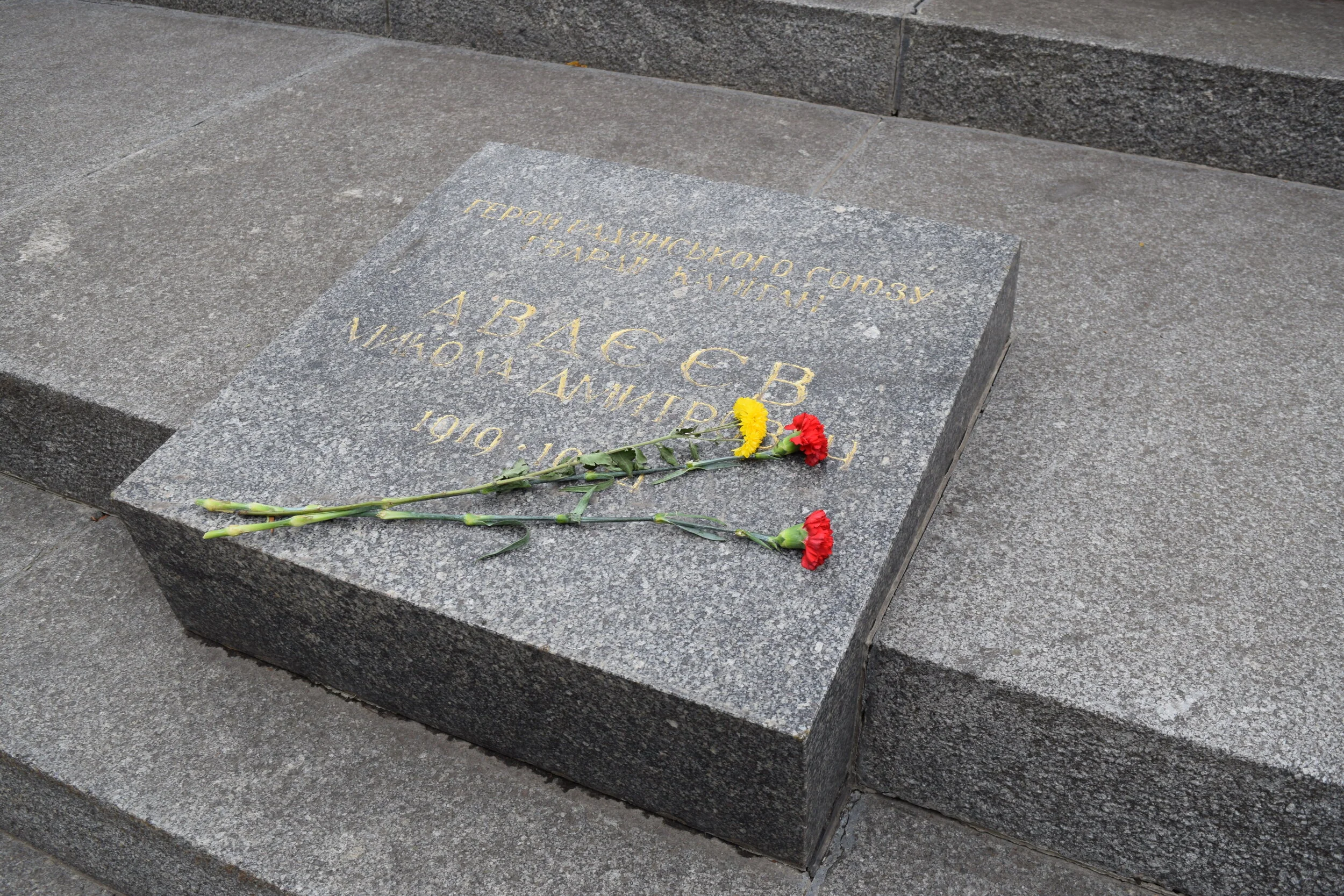
Flowers on a tomb
Holodomor Monument
One of the monuments that you cannot miss in Kyiv is the Pechersk Lavra Monastery, a UNESCO Heritage Site since 1990. It has an entrance fee of 50 UAH (approx. €1.80).
This Orthodox Christian Monastery, founded in a cave in 1051, has grown along the centuries until becoming the big complex of churches that we find today, one of the main centres of worship in Eastern Europe.
You’re welcomed into the monastery by the Great Lavra Belltower. With a height of 96.5m, it was the tallest free-standing bellower when it was finished in 1745.
Pechersk Lavra Monastery
Behind it stands the imposing Dormition Cathedral, the main church of the monastery. The first construction was built in wood during the 11th century by the monks that used to inhabit the caves located in this area.
After the first church was destroyed by a fire, it was rebuilt in 1470 to be destroyed only 12 years later. The monks that inhabited the caves were invaded, expropriated and persecuted for years, until a new cathedral was inaugurated only in 2000, ensuring that the monastic life in the area remains active.
Dormition Cathedral
Paintings on the celing
Internal decoration
Also inside the complex is the Church of Sts. Anthony and Theodosius of Pechersk, built in a Neo-byzantine style in 1893-95. The structure consists of two parts, the first one is the octagonal Church with a hemispheric dome, while the second one is the two-story rectangular refectory chamber.
In 1941, the building was seriously damaged as a result of the explosion of the Formation Cathedral. After the German occupation, the roof was dismantled, losing all its paintings. Repair and conservative activities started in 1945 and went until 1965. The church has been used again as a place of cult since 1991.
Church of Sts. Anthony and Theodosius of Pechersk
Entrance to the church
Inside
The complex is quite big, you can easily spend hours visiting all the different churches, caves and exhibitions. Seeing as the weather was getting worse and worse, I visited only the main highlights trying to avoid the rain.
I left the monastery for a late lunch at the traditional Tsarskoe Selo Restaurant before continuing to the last stop of the day, the National Museum of the History of Ukraine in the Second World War. This massive memorial complex was inaugurated on May 9th, 1981, the same day that Nazi Germany surrendered in 1945.
Covering over 10 hectares overlooking the Dnieper River, the memorial includes multiple sculptures, military equipment for the time, as well as a museum with exhibitions about World War II and Ukraine’s role in it.
Right on top of the museum stands the gigantic Motherland Monument, a 62-meter tall statue that represents Ukraine, holding a sword on the right hand and a shield with the Coat of arms of the Soviet Union on her left hand. It is one of the most recognisable landmarks of Kyiv.
Tanks near the museum
Cannons
National Museum of the History of Ukraine in the Second World War
It was starting to rain, so I decided to get an Uber back to my hotel and get some rest before heading for a night at the Opera.
I’m not a huge fan of Opera, and to be honest I had never attended an opera before. Opera tickets in Kyiv are extremely cheap, starting at about €3 and going to a maximum of about €25 for the best seats. Since they were performing the famous Carmen by the French composer Georges Bizet during my stay, I decided to give a go. The best tickets tend to sell out in advance, so I do recommend booking online from the National Opera and Ballet Theatre of Ukraine website.
The interior of the opera may not as impressive as other buildings, such as the famous Opera Garnier of Paris or the Teatro La Fenice in Venice, but it is still beautifully decorated. Its small size also makes it very cosy and with a great view no matter where you seat.
I found the artists and the performance outstanding, but I do recommend reading the plot of the opera in advance. It may spoil you the end, but otherwise, you will most likely get lost. The entire show was subtitled in Ukrainian on a small screen at the top of the stage, but that didn’t really help as unfortunately, I don’t speak the language. Even if you speak the original language of the opera, French in the case of Carmen, it can be hard to understand due to the exaggerated performances of opera singers and their strong Ukrainian accent.
If you’ve never seen an opera before and would like to give it a try without spending a fortune, I do recommend buying tickets!
National Opera of Ukraine
Ceiling
Performance of Carmen
Day 3
My last day in Kyiv was much more relaxed than the previous two. Since I didn’t have many tourist attractions left to visit, I decided to learn more about the history of the city and joined a free Revolution tour with Freetour.com. It leaves at 11 am from Independence Square every Monday, Tuesday, Thursday and Saturday, and you can book it in advance or just show up at the meeting point.
The tour focuses on the Revolution of Dignity, also referred to as Euromaidan. It was a Ukrainian nationwide protest movement that lasted from November 2013 to February 2014. Our guide, a local who took part of the Euromaidan, introduced us briefly to the history of Ukraine and its relations with Russia so that we could understand how these historic events were precipitated by the abrupt rejection of the European development foreign policy vector, and the last-minute refusal to sign the EU Association Agreement by Ukraine’s former leadership.
Following the brutal beating of young people by the government special forces in Kyiv’s main square, Maidan Nezaleshnosti (Independence Square), the protest movement developed into a longstanding civil disobedience campaign against unchecked state power, corruption and human right abuses.
Child with an Ukrainian flag
On the evening of November 21st, 2013, shortly after the disclosure of the government’s decision to suspend preparations for the signing of the EU Association Agreement, citizens began to organize themselves through social media networks for the first protest rally that took place on Kyiv’s main square.
Approximately 1,500 individuals, including journalists, community activists, and leaders of opposition political parties gathered on Maidan that evening, and some stayed overnight. That’s how Euromaidan began.
During the last week of November, numerous protests meetings were held in all regional centres of Ukraine in support of signing the EU Association Agreement. University students in Kyiv and Lviv went on strike.
Beginning with 22 November, the government made several attempts to disperse the peaceful demonstrators under the pretext of decorating the main square for the holiday celebrations, which led to clashes between the activist and state forces. Most of the governmental forces came from Crimea, a pro-Russian region of Ukraine that Russia would annex only 3 months later.
Demonstrators in Independence Square
Demonstrators took brick from the pavement to defense themselves
Barricades
On November 30th, 2013 at around 4 am, when only about 400 activists remained on Maidan Nezalezhnosti, the ‘Berkut’ armed special militia force surrounded the main square and attacked the activists.
During this operation, the task force used tear gas and explosive devices. The activists were brutally attacked, and those who ran were followed and viciously beaten. Some of the activists, who managed to escape the vicious beating of the government special forces, found protection within the walls of the St. Michael’s Golden-Domed Monastery.
The next day there shocking images of the attack on Maidan ripped through the media and marked the point of no return in the course of events that followed.
Armed demonstrators
On December 1st, more than a million Ukrainians participated in a protest march. Demands to oust what they considered a criminal government began to be openly voiced at this time. The Headquarters of National Resistance was formed and situated at the Trade Unions Building on Independence Square.
On December 8th, millions of Ukrainians joined in the March of Millions through Kyiv’s streets. The protesters began to erect the first protective barricades against the threat posed by state authorities. At this point, the self-regulated and horizontal organisational structure of Maidan was actively developed: tents and camps were set up, the stage began to function as a platform for coordination and speeches by activists, artists and politicians; several kitchens, an emergency medical unit, a warm clothes collection point, and donation points were set up.
Solidarity campaigns in support of Ukrainian protesters were held in more than 20 countries. After the protestors were beaten by the authorities on November 30th, steps needed to be taken to protect the Maidan from such punitive measures. This led to the creation of a Maidan Self-Defense group. This volunteer self-defence unit was tasked with maintaining order within the tent camp and protecting the areas controlled by the Maidan Protestors from the authorities.
Euromaidan
February 14th was the turning point of the protests. The authorities had been trying to force the protestors out of the city centre for more than a month, but that day and without any previous warning many protestors started getting shot by unknown snippers. They first thought that the shots were coming from the Hotel Ukraine, and although protesters blamed the government forces, they always denied having used snippers to kill the protestors.
A total of 107 people died in the Euromaidan, known as the Heavenly Hundred Heroes. They are remembered all over Independence Square and its surroundings, where you can find multiple memorials with the names and pictures of all those who were killed.
On the night of February 22nd, 2014 President Yanukovych fled to Russia on a charter flight. Tactically, the Euromaidan managed to force the president to flee and his government to resign. After elections, Ukraine chose a European vector of development. It became an EU associate member, its citizens attained the right to visa-free travel entry into the European Union, and as a result of the EU-Ukraine Free Trade Agreement, trade with European countries has significantly increased. Strategically, the country turned its back on its past, the ‘Prison of Nations’, as Ukrainians commonly refer to the Soviet Union.
Memorial to the Heavenly Hundred
Plaques in honour of the victims
Ribbons with the Ukrainian colours
The Revolution tour was a fantastic opportunity to get familiar with the recent history of Ukraine. I remember seeing these marches on TV years ago without really understanding what was going on, so getting a better understanding of the past and current political situation of the country did help.
From Independence Square I continued to the Horedecki House, or House with Chimaeras. This Art Nouveau building can be found just in front of the President of Ukraine’s office, and it’s currently used as the presidential residence for official ceremonies.
The name of the building comes from its elaborate decorations depicting exotic animals, a style known as chimaera or grotesque. The sculptures are the work of the Italian architect Emilio Sala. The external decorations include statues of frogs, dolphins, eagles, mermaids or elephants. You won’t find anything like this anywhere else in Kyiv!
Horedecki House
We stopped for lunch at the high-end BEEF meat & wine restaurant before continuing to the Taras Shevchenko University. It is the third oldest university in Ukraine, consisting of fifteen faculties. It was funded by the Russian Tsar in 1834, and it became one of the most respected universities in the USSR.
I mainly came here to see the famous main building, built in 1843 in the Russian Classicism style, with its red façade and black capitals and columns.
Taras Shevchenko University
I dedicated the rest of the afternoon to visit the Chernobyl Museum. I would visit the actual site of Chernobyl the next day, so I wanted to get some additional insight into the accident to get a better understanding of the visit.
The museum has a very informative exhibition with visual media and artefacts that cover the tragedy in detail. The museum is highly interactive, which makes the visit even more interesting.
Entrance is very cheap, only 10 UAH (approx. €0.4). If you want to take photos, you need to pay an additional 30 UAH (approx. €1), and they also offer audio guides in different languages for 50 UAH (approx. €1.80). I highly recommend the audio guide, the explanations are very detailed and a great complement to the exhibition.
Chernobyl Museum building
Exhibitions of cars at the entrance
Chernobyl Museum
As you get the stairs, you’re welcome with a display of rod sign for all the towns abandoned after the Chernobyl disaster. In the first room, a big clock is stopped at 1:23 am, the exact same time of the explosion.
I won’t go into details about the Chernobyl disaster, as I will be posting about my full-day visit to Chernobyl, but do recommend the Chernobyl Museum. Whether you want to learn more about the disaster before or without visiting the site, the museum gives an incredible about the biggest nuclear disaster in history.
Entrance to the museum
Clock stopped at the time that the accident took place
Model explaining how the plant worked
Gas mask
Chernobyl Museum
First international news about the accident
Classified document communicating the accident
Memorial to the victims
Nunclear plants in the world
‘Contaminated’ sign
Chernobyl Museum
The Chernobyl Museum put an end to my 3-day visit of Kyiv, the fascinating capital of Ukraine. Although still a very off the beaten track city, the popularity of Kyiv is growing every year, and for a reason! The city is filled with interesting sites, and its very cheap prices make it the perfect destination for a long weekend, or as part of a longer visit to Ukraine.
Next day, I would take a full day trip with GammaTravel to visit Chernobyl and the ghost town of Pripyat, a visit 30 years after the biggest nuclear disaster in history.
All opinions are my own.
Where to sleep in Kyiv

Olga Apartments
I honestly couldn’t be any happier with my choice of accommodation in Kyiv. I decided to book an entire apartment with Olga Apartments, which wouldn't have been a better choice!
They offer a few different options, and the apartment that I selected was located in Borysa Grinchenka street, literally at the entrance of Independence Square. I had the main hub of the city and all tourist attractions and the reach of my palm!
The interior of the apartment was quite new and very spacious, it could easily fit 4 people. It came with a fully equipped kitchen and very modern bathroom, but nothing could compare to its incredible location; I couldn’t have been more central. You can expect to pay around €37 per night for the entire apartment.
Where to eat in Kyiv
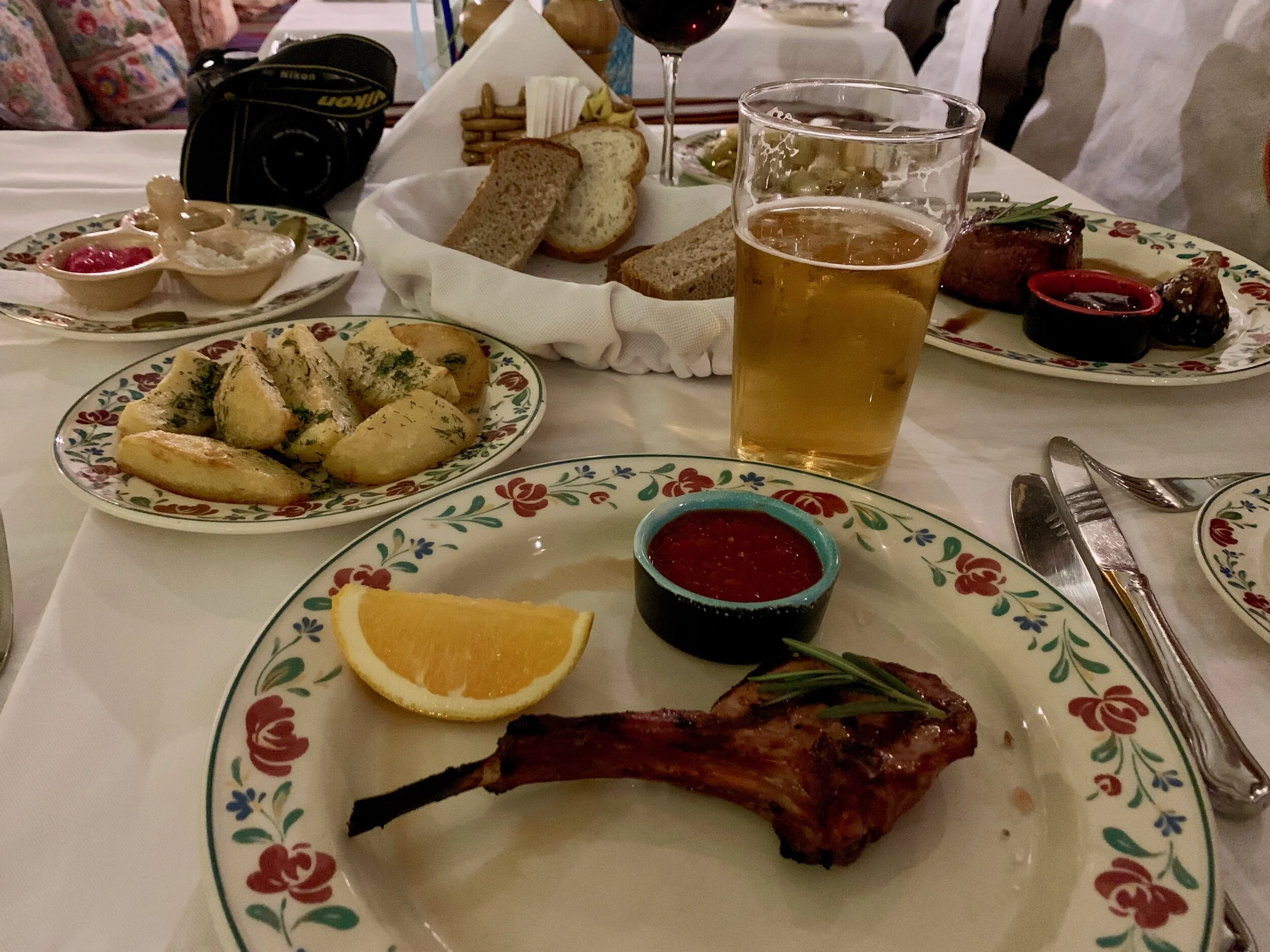
Tsarske Selo
Tsarske Selo is a traditional Ukrainian restaurant located just next to the Pechersk Lavra Monastery.
Here you can find some home-made Ukrainian dishes following the traditional recipes, and its several lounges are all decorated with a very traditional Ukrainian style.
Prices are slightly higher than what you’ll find in most restaurants of Kyiv but still pretty decent. I paid 1002 UAH (approx. €39) for two people for a steak, lamb, chips, a beer and a glass of wine.

BEEF meat & wine
If you’re looking for a fantastic gastronomic experience, you should pop by BEEF meat & wine. It has been recognised twice as the 'Best Ukrainian Meat Restaurant' and as its name suggests, it specialises in pairing delicious meat with the best international wines.
The meat is cooked on a four-meter parrilla grill and in wood-burning stoves, which reflects in the incredible quality and taste.
Prices are much higher than the average in Kyiv; I paid 1500 UAH (approx. €60) for a hamburger and a steak, both with chips, and two glasses of wine. Considering the quality and that this is a high-end restaurant, it didn’t find the bill that excessive, especially if compared with similar restaurants in other western European capitals. I highly recommend it if you’d like to give yourself a treat!

This article is now available as a mobile app. Go to GPSmyCity to download the app for GPS-assisted travel directions to the attractions featured in this article.


On April 26th 1986, an explosion took place at reactor number 4 of the Chernobyl Nuclear Plant, releasing radioactive material to the air and causing the biggest nuclear disaster ever recorded in history.
With hundreds of deaths as a result of the high radiation levels, a 30km Exclusion Zone was established around the Chernobyl disaster area that still remains until our days. Pripyat, a city of 50,000 inhabitants built only a few years earlier for the workers of the plant and their families, had to be evacuated within hours. Its inhabitants would never return home.
Today, accessing the Chernobyl Exclusion Zone is still highly restricted, but you can easily get a permit by joining one of the guided visits that depart daily from Kyiv. Check out my experience visiting the Chernobyl Exclusion Zone and the ghost town of Pripyat to discover the results of the biggest nuclear accident of all times!