
2 days in Krakow - Part I: highlights of the Old Town
The city of Krakow, former capital of Poland and seat of the Polish monarchs for centuries, is without a doubt one of the most charming cities in Europe. Its beautifully preserved medieval Old Town, where you can find most of the places of interest of this Unesco World Heritage city, is one of the few places in Poland that escaped from complete destruction during World War II.
During my first day in Krakow, I explored all the highlights of the Old Town, starting in Market Square and following the Royal Road from St. Florian’s Gate all the way to Wawel Castle, the former residence of the kings. Check out this itinerary to discover one of the liveliest cities of Poland!
how to Get to Krakow
During the last few years, Krakow has become one of the preferred European destinations for a short getaway. Thanks to this, the city is very well connected with most European cities by dozens of airlines that land at the John Paul II Kraków-Balice International Airport.
If you’re coming by air, buses 208 and 252 will bring you to the city centre in less than 45 minutes. Bus 208 leaves every hour and stops at the Dworzec Główny Wschód central station, while bus 252 departs every 30 minutes and stops at the ICE Congress Centre on the south side of the city. One-way tickets only costs 4 złoty (approx. €1)
Market Square
The most convenient option from the airport is the train, as you will reach the city centre in only 20 minutes. Trains depart every 30 minutes and stop at Kraków Główny, the main train station. A one-way ticket has a cost of 9 złoty (approx. €2)
If you rather get a taxi, they have fixed rates depending on which part of the city you're staying. The fixed rate for the city centre is 90 złoty including luggage (approx €21). All taxi ranks have a map showing the different tariffs depending on where you’re heading to.
If you’re coming by land, there are multiple bus and trains that arrive from other cities in Poland or one of its neighbouring countries. For buses, you can plan your journey as well as check schedules and prices on the E-Podróżnik.pl website. From the Intercity.pl website you can also check timetables and buy your train tickets, if you prefer to use this method of transportation.
History of Krakow
Krakow is one of the oldest cities in Poland, with settlements that date back to 50,000 BC around the Wawel Hill. The first time that the name of the city was recorded was in 966, when it became a very busy commercial centre.
During the 9th century, the region was governed by the Moravians, followed by the Bohemian rule before the territory was incorporated into the principality of the Piast dynasty, creating the Kingdom of Poland in 990. In 1038, Krakow became the capital of Poland, with the Wawel Royal Castle as the residence of its kings.
Wawel Cathedral
It was during the reign of Kazimierz the Great in 1333 that the city reached its peak, who expanded the Wawel Castle and founded the famous Jagiellonian University. This period was the golden age of Krakow, when it became a cultural centre for artists and humanists. However, the city saw its decline from 1596 when Sigismund III decided to move the capital to Warsaw.
In 1772, the Austrians, Russian and Prussians troops invaded the prosperous Polish-Lithuanian Commonwealth, leading to the First Partition of Poland. Only 21 years later, Russia and Prussia would again invade the country and carry out the Second Partition of Poland. In 1795, Poland was partitioned for the third time and was incorporated into the Austrian Empire.
At the start of First World War in 1918, the Russian troops invaded the city once again, liberating Krakow from the Austrian rule. Thanks to the Treaty of Versailles, the country became a sovereign state for the first time in over 100 years. But Poland wouldn’t be an independent nation for long, as in 1939, the Nazi forces invaded the country and set their rule upon it.
This was by far the darkest period of Krakow, when over 150 professors from the Jagiellonian University were sent to concentration camps and the Jewish population was expelled from the Jewish Quarter of Kazimierz and confined into a ghetto just outside of the city. The ghetto was liquidated in 1943 and all its occupants were either killed or sent to the concentration camp of Auschwitz. During the Holocaust, the vibrant Jewish history and population of Krakow, which at one point formed the 25% of the city’s inhabitant, was completely destroyed.
The German occupation was replaced by 45 years of communist rule until the country obtained its independence via free elections in 1989, just before the fall of the Soviet Union. Today, Poland is a modern state trying to recover from the suffering of the past. The country joined the European Union in 2004 and Krakow, one of the only few Polish cities that wasn't completely destroyed by the war, became one of the main historical and cultural centres of the country.
What to see in Krakow
The Old Town of Krakow is one of the most charming historical ensembles in Europe, comparable to the beautiful cities of Lviv in Ukraine or Riga in Latvia. In spite of the destruction of the Second World War, many of the historical buildings in Krakow were preserved in a pretty good state, contrary to the capital Warsaw which was completely destroyed by the bombs and the current Old Town was reconstructed from scratch after the war.
The best place to start exploring the city is the Market Square, one of the biggest medieval squares in Europe. Surrounded by most of the historic houses and churches of the city, the Market Square is the heart of Krakow.
It dates back to the 13th century when it was the main place for commerce in the city. The square was designed with a pattern of three evenly spaced streets on each side of the square. The only exception is Grodzka Street, which is much older than the square and currently connects it with Wawel Castle.
I particularly liked the square as it is the liveliest part of Krakow, filled with cafes, restaurants and street musicians. On the west side of the square, you can also find horse-drawn carriages that will take you around the Old Town during 30 minutes for a price of 200 to 300 złoty (approx. 46 to 70 euros).
Main Square & St. Mary’s Basilica
Main Square
Me at the Main Square
On one of the corners of the Market Square you will find St. Mary's Basilica. Built in the 14th century, it represents one of the best examples of the Polish Gothic constructions.
Every hour, a trumpeter plays a trumpet signal from the taller of the two towers. The music is stopped abruptly before the end to commemorate a famous trumpeter that was shot in the throat back in the 13th century when he was sounding the alarm when the Mongols were about to invade the city.
St. Mary’s Basilica
Statue of the poet Adam Mickiewicz in front of the basilica
Interior
Right in the centre of the square stands the Cloth Hall, one of the symbols of the city. It reached its peak during the 15th century as a centre of trade, when merchants from all over Europe sold here their textiles.
The hall started to decline when the capital was moved to Warsaw at the end of the 16th century followed by the devastating wars and Partition of Poland in the 18th century. It wasn't until the end fo the 19th century that the hall saw its revival after a complete renovation carried out by the Polish architect Tomasz Pryliński.
Cloth Hall
Terrace near the Cloth Hall
St. Mary’s Basilica & Cloth Hall
On one side of the Cloth Hall stands the Town Hall Tower, the only remain of the old Town Hall, which was demolished at the beginning of the 19th century to open up the square. This is the reason why the Main Square of Krakow doesn't have a town hall, contrary to most European squares.
This 70m high tower was built in the 13th century in a Gothic style that still preserves. Today, the tower houses one of the branches of the Historical Museum of the City of Krakow, with an exhibition of photographs of the Market Square. The top of the tower also offers incredible panoramic views of Krakow.
At the feet of the tower you will find one of the best-known landmarks of Krakow: the 'Eros Bendato' bronze statue, commonly known as 'The Head'. Designed by the Polish artist Igor Mitoraj, the statue was originally meant to be placed outside the Galeria Krakowska. However, after the complaints from the artist for having his work piece placed outside a shopping centre, the statue was placed near the Town Hall Tower, becoming an unexpected tourist attraction.
Town Hall Tower
Town Hall Tower & Cloth Hall
Eros Bendato statue
Following Florianska street on the north side of the square you will reach St. Florian’s Gate, a 14th-century Gothic watchtower that was part of the city fortifications against the Turkish attacks.
This 33m tall gate was the main entrance to the Old Town and used to be surrounded by a moat that protected the city from invaders. St. Florian's gate is the only remaining of the 8 towers built during the Middle Age, dismantled in the 19th century when the city of Krakow was modernised.
Here also begins the famous Royal Road, the path that connects the northern part of the Old Town with the Wawel Hill, where the formal royal residence was located. The road passes by most of the main landmarks of the former royal capital of Poland, so this was pretty much the itinerary that I followed during the rest of my visit.
St. Florian’s Gate
Paintings near the gate
Defensive walls
Crossing St. Florian's Gate and just outside the Old Town, I stopped for a quick visit to the Barbican, a fortification that was part of the former city walls. Built in 1498, it's one of the few fortified outposts left in Europe, and one of the best preserved.
The barbican used to be connected to the city walls through a passage that led to St. Florian's gate. It served as the main checkpoint for everyone that wanted to access the city of Krakow.
As I headed back to the Old Town on my way to Wawel Hill, I stopped by some of the beautiful churches hidden in the streets that surround the Market Square, including the Church of the Transfiguration and the beautiful Church Of St. John the Baptist and John the Evangelist with its red façade.
The Barbican
Church of the Transfiguration
Church Of St. John the Baptist & John the Evangelist
Another point of interest before reaching the hill is the Jagiellonian University of Krakow. It was founded in 1364, which makes it the oldest university in Poland. With over 40,000 students, it's one of the biggest and most reputable centres of study in the country.
The university was established by King Casimir III the Great in an attempt to educate the population of Poland, and some of the most famous alumni include the astronomer Nicolaus Copernicus, the poet Jan Kochanowski or Andrzej Duda, a former President of Poland. Karol Wojtyła, who would later become Pope John Paull II, also studied at this university for one year, but he didn't complete his studies here.
Building of the university
Statue of Copernicus
Jagiellonian University
At the foot of the university starts the ascent to Wawel Castle, the former residence of the kings of Poland. Built by Casimir III the Great during the 13th and 14th centuries, this architectonical ensemble was expanded during the centuries, representing almost every European architectural style, such as medieval, renaissance or baroque.
It reached its maximum splendour during the 16th century when King Sigismund I the Old brought the best artists and sculptors to transform the castle into a Renaissance palace that would become a symbol in Central and Eastern Europe.
The castle was neglected after the capital was moved to Warsaw in 1609, but it so an even bigger decline after the Swedish and Prussian invasions. It wasn't until 1905 that the renovations of the castle started, and after becoming the residence of the President of Poland in 1921, it finally was transformed into a national museum after World War II.
As you climb the ramp and cross the Lower and Vasa Gate, the equestrian statue of Tadeusz Kościuszko, a Polish and American hero of independence, welcomes you to the castle.
Wawel Hill
Lower Gate
Vasa Gate
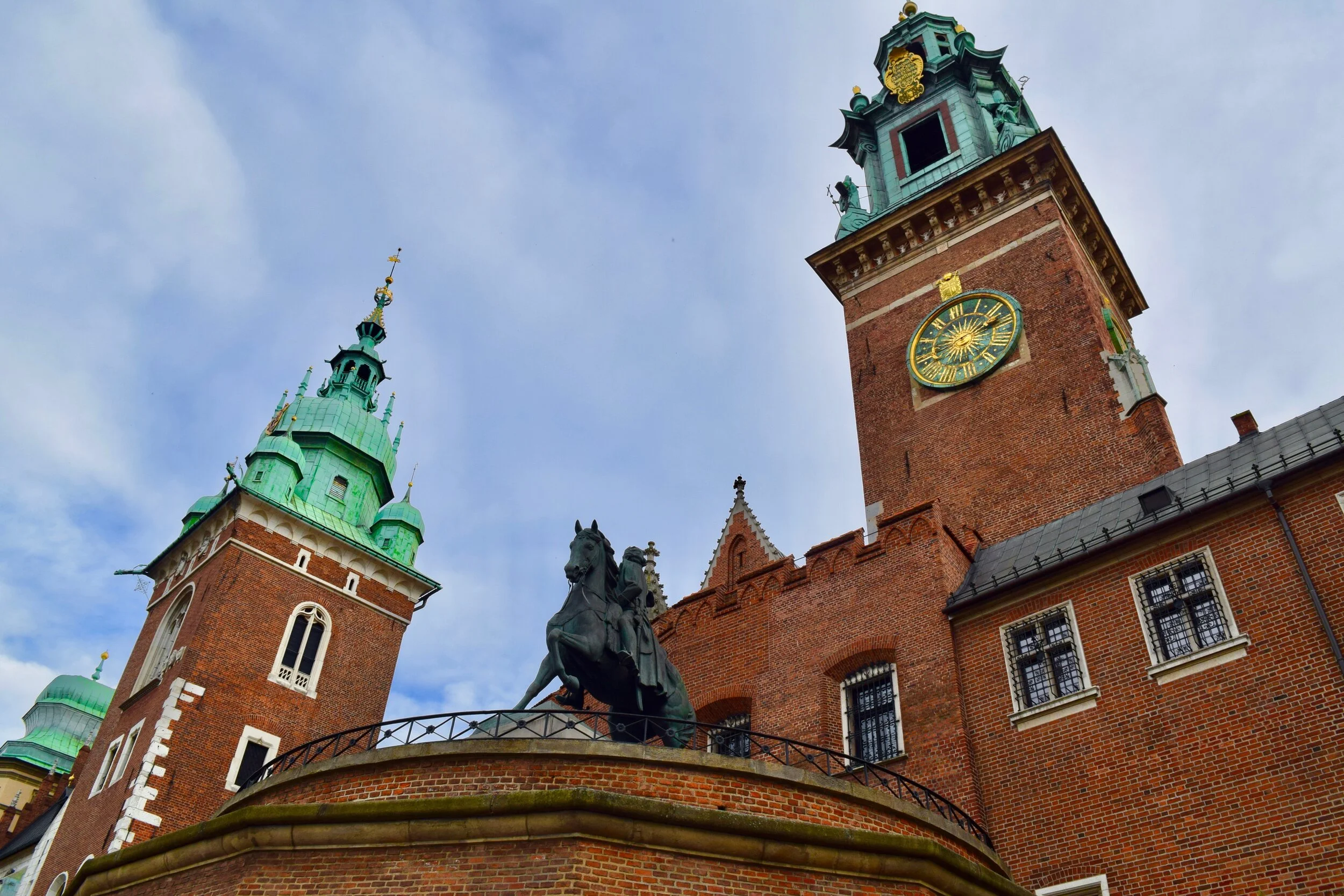
Statue of Tadeusz Kościuszko
The main symbol of Wawel Castle is the Royal Cathedral, a testimony of the history of the Polish nation and a centre of religious reflection. Its history dates back to the very beginning of the Polish statehood, and due to its unique, artistic and patriotic value, Wawel Cathedral is considered one of the most important sacred buildings in Poland.
The cathedral itself is free of charge, but visiting the Royal Tombs and Sigismund Bell has an entrance fee of 12 złoty (approx. €2.80). Inside, you can find the High Altar, which used to be the coronation altar of the Polish kings for 400 years. The first cathedral on Wawel Hill was built in the year 1000, with a second cathedral consecrated in 1142 that was destroyed by a fire in 1305. Shortly after in 1320, the Bishop of Cracow, Nanker, initiated the construction of the third Wawel Cathedral in a Gothic style which has survived to this day.
Wawel Cathedral is also the burial place for Polish monarchs in its Royal Tombs. The first king to have been buried at Wawel was Władysław the Short. Beginning from Kazimierz Jagiellon, the rulers have been buried in special chapels added to the cathedral. King Sigismund I the Old and his successors, along with members of royal families, have been buried in underground cathedral crypts that can also be visited.
Since the very beginning, Wawel Cathedral has resounded with the sound of bells. Currently, there are eight bells in two bell towers. Special ceremonies at the cathedral are accompanied by the special sound of the Sigismund Bell, which weighs over 12 tons. It was commissioned by King Sigismund the Old in 1521.
Wawel Cathedral
Me at Wawel Castle
Interior
Sigismund Bell
Included with the cathedral ticket is the John Paul II Cathedral Museum. The museum houses historical pieces from the cathedral since in 1975 cardinal Karol Wojtyła, future Pope John Paul II, transformed the buildings into a Cathedral Museum, were objects form the Wawel Cathedral would b kept.
Its eastern part, adjoining the Vasa Gate, was formerly a tenement built in the time of Casimir the Great. The Gothic House, seat of the college of Cathedral missionaries who performed the liturgy in St. Mary’s chapel', forms the western part.
Statue of John Paul II outside the Cathedral Museum
But the main exhibition of the castle is the State Rooms, the former public rooms of the palace where the Polish kings received their guests. Today, the interior displays a collection of tapestries as well as royal portraits and paintings by Italian and Dutch artists. It has an entrance fee of 20 złoty (approx. €4,50).
You can also visit the Royal Private Apartments where the monarchs used to live. The inside still preserves the original wood ceilings and painted walls and dozens of paintings from Northern European and Italian artists. It has an entrance fee of 23 złoty (approx. €5,30).
Gardens of the castle
Tired arcades in Wawel Castle
Courtyard
As the day was approaching to an end, I started descending from Wawel Hill back to the Old Town right at the sunset, when the buildings of Wawel Castle turned into fascinating tones of gold and orange.
Just before I left the castle, I stopped by the Wawel Dragon statue, dedicated to the mythical creature that according to the legend lived at the foot of the Hill, next to the Vistula River.
In the legend, the dragon terrified the locals by destroying their houses and eating up their daughters. To resolve the issue, King Kraus promised the hand of her daughter to the man who could kill the dragon. A man named Skuba took the challenge and stuffed a lamb with sulphur for the dragon to eat, who drank so much water from the river to relieve his thirst that ended up exploding.
Wawel Cathedral at sunset
Wawel Dragon statue
Wawel Castle at sunset
View of Wawel Hill
But Krakow has much to offer outside the Old Town. With one of the biggest Jewish populations in Europe up until the 20th century, the city has multiple sites of relevance associated with their culture.
Next day, I would leave the Old Town behind to explore Kazimierz, the former Jewish Quarter, before heading to the former Jewish Ghetto and Oskar Schindler’s Factory to discover the story of the German industrialist and member of the Nazi Party who saved the lives of over 1,200 Jews during the Holocaust.
Where to…
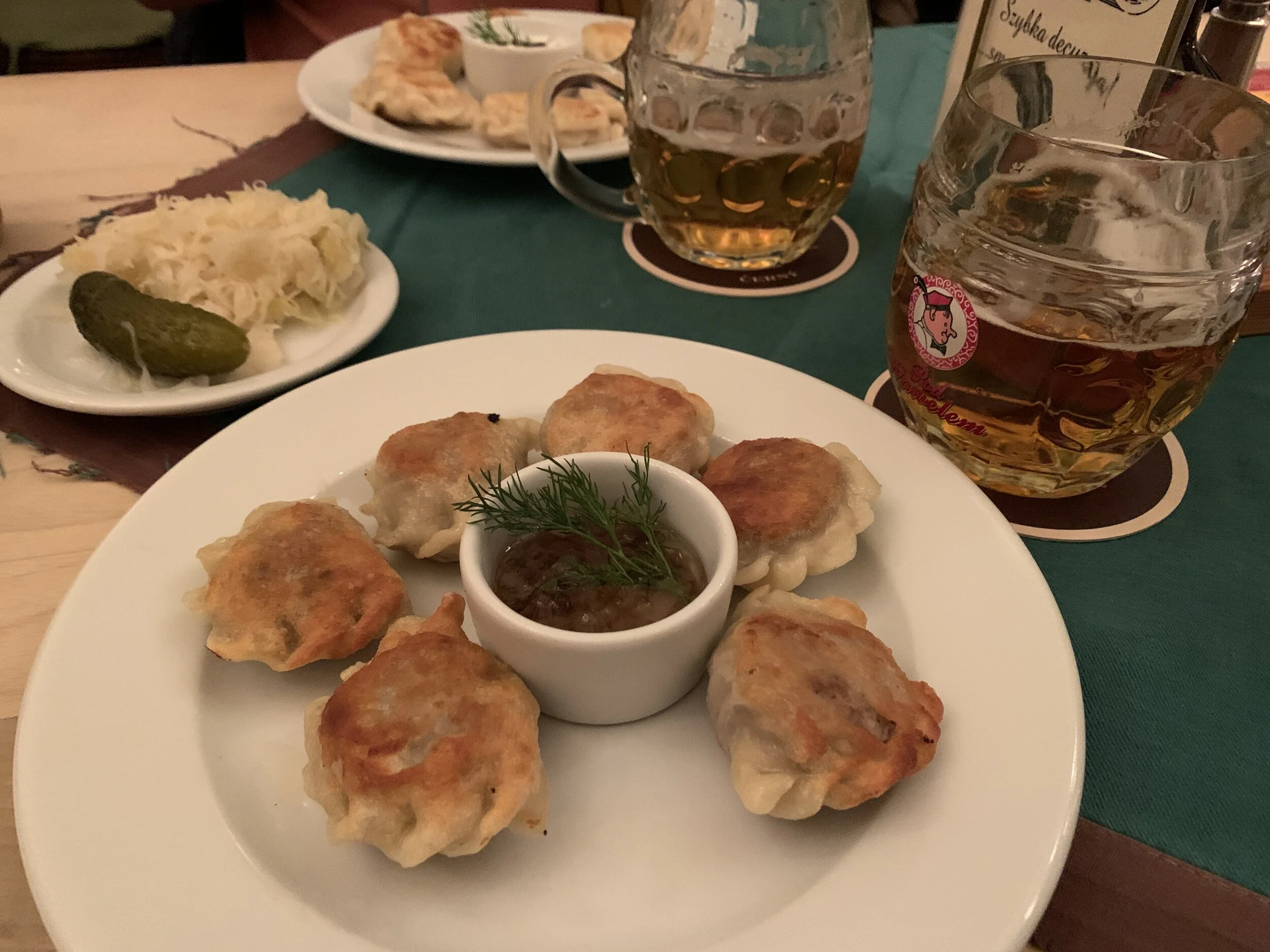
Eat in Krakow
If you’d like to try some delicious Polish food in a great atmosphere, Pod Wawelem is a great choice.
Located at the feet of Wawel Castle, this restaurant serves traditional food in pretty big portions; we tried two dishes of dumplings (one filled with pork, the other ricotta cheese) as well as a board of meat for two and the amount of food was huge!
Pod Wawelem is also a beer hall, so don’t forget to ask some of the local beers. Prices are pretty reasonable, I paid about €15 per person for all that food and the drinks.
Every night, they play folk Polish music, which makes the place even more special. Highly recommended!
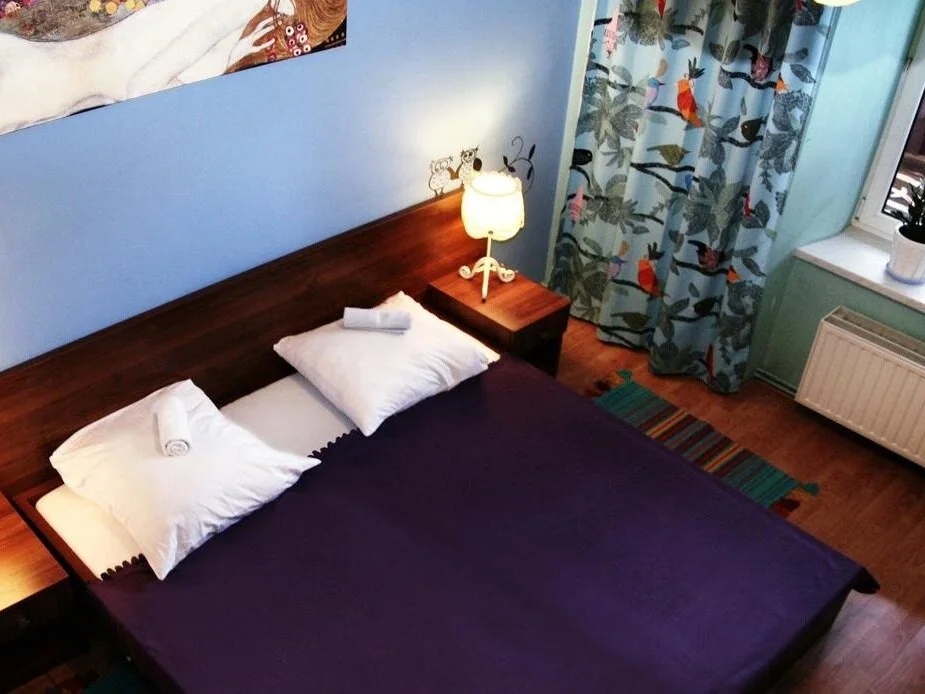
Sleep in Krakow
If you’re looking for cheap accommodation in a very central location, High Life Hostel may be your place.
Located only an 8 minutes walk from the Market Square, this hostel offers both private and dorm rooms with either private or shared bathroom facilities. Rooms are extremely spacious, which is a plus!
Although the facilities are quite basic, the hostel also offers a common area with a kitchen.
Considering the location, prices are very competitive, at around €33 per night for a private double room.
Some links in this post are affiliate links, which means that if you buy through them, we’ll receive a small commission. This will never cost you more and in many cases you will receive a special discount.
As always, all opinions are mine. We appreciate your support!


Symbol of the atrocities of the Holocaust, the Auschwitz-Birkenau Concentration Camp is one of the most infamous places on Earth. After all, it was here that over 1,1 million people, mainly Jews, died during World War II at hands of the Nazis in the biggest extermination campaign ever seen in history.
During my visit to Krakow, I booked a guided tour to the Auschwitz I and Auschwitz II-Birkenau camps, a very tough but extremely educational and necessary visit to remember the horrors of the past to make sure that they are never repeated.