
15 day itinerary of Israel, Palestine & Jordan
If you’re organising a 2 week visit to Israel, Palestine and Jordan, check out this guide to learn how to plan your itinerary, what visa requirements you need, where to stay and some other useful information for your trip!
Israel, Palestine & Jordan: 15 day itinerary
When planning a trip to the Holy Land, choosing what to visit is probably the hardest part. I’d say that two weeks is the ideal time to explore all the main highlights of Israel and the West Bank, and you should also have enough time to take a 3 day trip to Jordan to visit this fascinating country. The itinerary that I followed during my visit was the following:
First day: departure from your destination and arrival in Ben Gurion Airport. Overnight in Tel Aviv.
Day 1: Tel Aviv, the modern city of the Middle East that never sleeps.
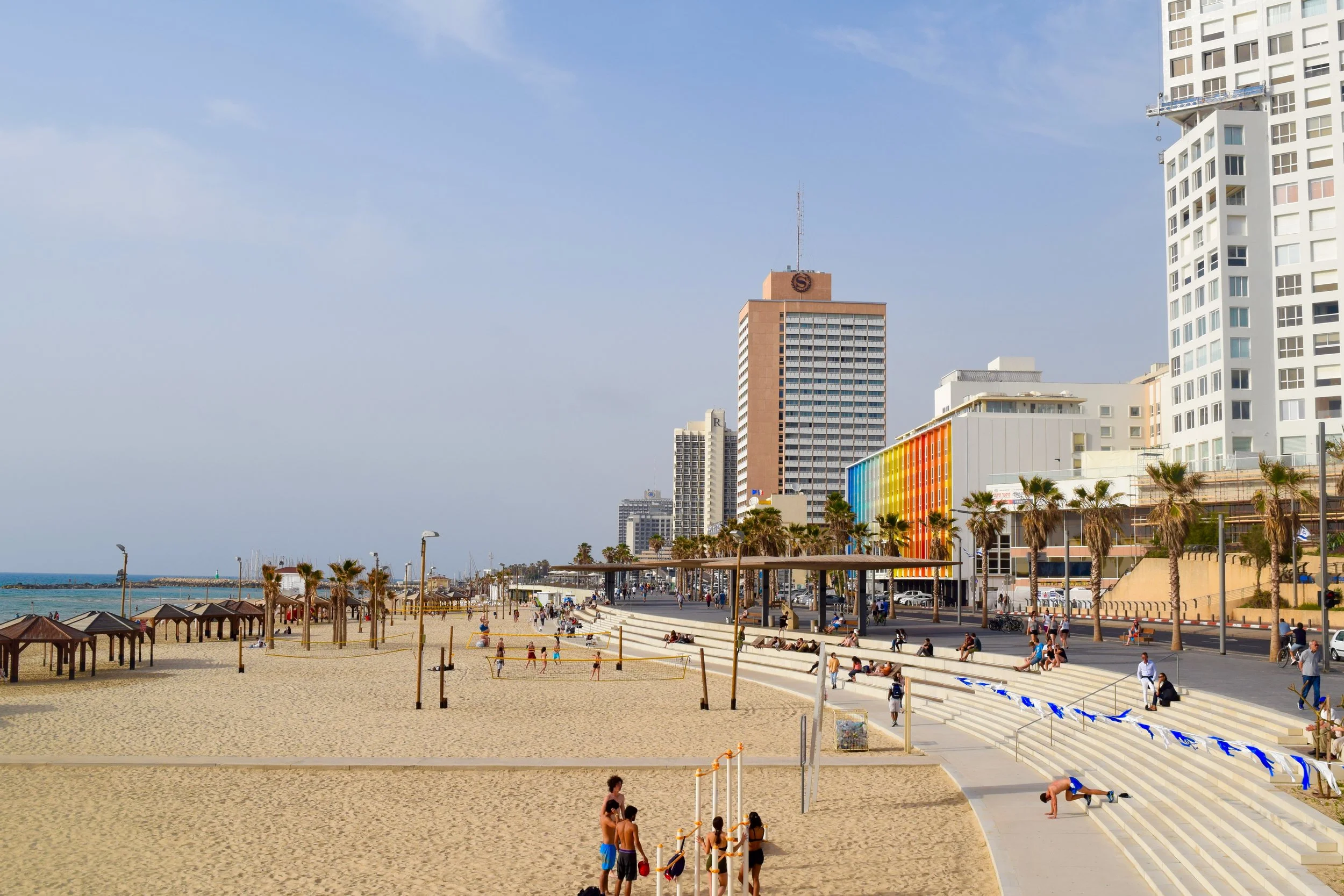
Full day in Tel Aviv to visit the Independence Hall and the Great Synagogue, Florentin Street with its impressive street art, and the neighbourhoods of Neve Tzedek and the German Colony. Continue visiting the buildings of the White City, a UNESCO Heritage Site, the Carmel Market, and finish by relaxing at the impressive Tel Aviv beach.
Day 2: Jaffa, the Arab port city of southern Tel Aviv.
Take a guided tour of Jaffa, a beautiful Arab city located south of Tel Aviv with thousands of years of history that date back to the Old Testament.Day 3: Nazareth, one day in the heart of the Galilee.
Travel early in the morning to Nazareth in the heart of the Galilee, where you can enjoy the Basilica of the Annunciation, where angel Gabriel announced to the Virgin Mary that she would be the mother of Jesus, the son of God.Day 4: Haifa & Acre, the north coast of Israel.
Day trip from Nazareth to the north coast of Israel, visiting the city of Haifa with its impressive Baha’i Gardens, and then continue to the Crusader town of Acre.Day 5: a day trip to the Sea of Galilee & the Golan Heights from Nazareth.
Day trip from Nazareth to the Sea of Galilee and the Golan Heights. At the end of the day, travel to Jerusalem for overnight stay.Day 6: Jerusalem: the four quarters of the Old City.
Visit the old city of Jerusalem, including the Christian quarter with the Holy Sepulchre, the Muslim quarter with the golden Dome of the Rock, the Jewish quarter and the sacred Western Wall, as well as the beautiful churches of the Armenian quarter.Day 7: learn about the history of Israel at the Tower of David & Mt. Zion.
Explore the Tower of David, followed by a visit to Mount Zion and King David’s tomb.Day 8: walking the Via Dolorosa.
Walk the Via Dolorosa, the path walked by Jesus on his way to the cross. If you have free time, explore two of the best museums or Jerusalem: the Holocaust Museum and the Israel Museum.Day 9: Temple Mount, Gethsemane, Mount of Olives & City of David.
Wake up early in the morning to go up to Temple Mount to visit the Dome of the Rock and Al-Aqsa Mosque during its limited opening hours. Next, go to the Garden of Gethsemane and the Mount of Olives, where some of the most important events of the New Testament took place. Continue with the City of David, the archaeological site where the city of Jerusalem originated over 3000 years ago. Finish the day by booking a guided visit to the Western Wall tunnels.Day 10: Best of the West Bank from Jerusalem: Ramallah, Jericho, Qasr El-Yahud & Bethlehem.
Take a day trip to the West Bank, visiting the modern capital Ramallah, Qasr el-Yahud baptism site, as well as Jericho, the oldest inhabited city in the world. Finish the day with a visit to Bethlehem to explore the Church of Nativity and the wall that divides Israel and the West Bank.Day 11: Hebron, a dual narrative tour of the most divided city in the Middle East.
Dual guided tour in Hebron, a city divided in half between Israel and Palestine. Learn how it is like to live there by visiting both sides with an Israeli and Palestinian guide.Day 12: sunrise from Masada and visiting Ein Gedi Natural Reserve & the Dead Sea.
Wake up at dawn to see the sunrise from Masada, an impressive ancient fortress built on top of a mountain. Next, go to the Ein Gedi Natural Reserve, an oasis in the Judean Desert with stunning waterfalls and landscape. End the day with a visit to the Dead Sea to float in its salty waters and get covered in mud.Day 13: Jordan from Israel - Jerash & Amman.
Leave Israel for a 3-day visit to Jordan. Cross the northern border of Beit Shean and start exploring this fascinating country with a visit to the Roman city of Jedash. Continue with a visit to the Citadel of Amman, the capital city, before passing the night in a bedouin camp.Day 14: the Lost City of Petra.
Today is the big highlight of any trip to Jordan: visiting the Nabatean city of Petra, one of the New Seven Wonders of the World.Day 15: Wadi Rum desert, the valley of the moon.
Visit to Wadi Rum desert, setting of multiple Hollywood movies thanks to its resemblance with the surface of Mars. Travel back to Israel and return to Jerusalem by crossing the King Hussein / Allenby Bridge border.Final day: time to leave the Holy Land and travel back home.
Visa requirements for Israel, Palestine and Jordan
Most western countries do not need a visa to enter Israel or Palestine, including all countries in the European Union, the United States, Canada, most countries in South America, South Africa, Australia and New Zealand. The visa process for Jordan is a bit more complex, as most nationalities will need a visa to access the country.
To check if your nationality requires a visa to visit Israel, Palestine or Jordan and start the application process, you can use the search box below:
If you’re visa-exempt, all you need to do is show up at Ben Gurion airport, where you will receive an entry card. Israel no longer stamps your passports, as there are a few countries that won’t let you enter if you’ve previously been to Israel (including Iran, Lebanon, Iraq or Kuwait). In order to avoid this, the Israeli authorities give you a separate piece of paper that contains your photo, personal information and that works as your visa.
View of Jerusalem from the Mount of Olives
Access to the West Bank is controlled by the Government of Israel, so you do not need any additional visa or document to cross the border; if you’re allowed into Israel, you can also visit the Palestinian Territories. Note that Gaza is not open for tourism, so you can only visit the West Bank.
If you’re visiting Jordan from Israel, I would recommend going with a group rather than on your own. Visitors in a group of 5 people or more don’t need to pay for the Jordanian visa if they stay in the country for at least 3 days.
Jordanian visas can be pretty expensive, so you can use the money that you’ll spend with the visa to pay the guided visit, as the difference in price won’t be that big. Jordan is a fascinating place with lots to see, so I would dedicate a minimum of 3 days to fully appreciate this country.
City of Petra
When crossing to Jordan from Israel by land, please ensure that the Jordanian authorities do not stamp your passport.
As previously mentioned, many countries won’t allow you to visit if you’ve previously been to Israel. Even though the Israeli authorities won’t stamp your passport, having a Jordanian stamp from the land border will proof that you’ve previously been to Israel.
When you hand in your passport to the Jordanian immigration, ask them explicitly not to stamp your passport and they will give you a separate pace of paper that you can fill out and that they will stamp. This will leave your passport without any proof that you’ve previously been to Israel. I did this during my visit, and I was later able to go to Iran without any questions asked.
Visiting on your own or booking a guided tour?
I’d say that a combination of guided and independent visits would be the ideal. It is extremely easy to travel around Israel on your own, so in most cases you won’t need a guided tour. There are multiple bus lines that connect all main cities, and you can also find some free guided tours in big cities such as Tel Aviv, Jaffa, Nazareth or Jerusalem.
Guided tour in Hebron
There are some other places that are not easy to reach, especially if you want to combine multiple attractions in one day. This also includes the Palestinian Territories.
For these visits, I booked multiple guided tours with guided tours of Israel and Palestine with GetYourGuide, organised by Abraham Tours.
They offer multiple options from Tel Aviv, Nazareth and Jerusalem, so they are ideal to reach some part of the countries that cannot be visited with public transport. I booked all my guided tours with them and I couldn’t be any happier with their services.
For my visit to Jordan, I decided to book a 3-day tour to Jordan from Israel.
I only had 3 days to visit this country, so I found that this tour covered all the main highlights, and also took care of the transportation, accommodation, and visa. The itinerary and organisation were fantastic, so I would highly recommend this tour to anyone.
Accommodation
Sleeping in Israel can be pretty expensive. A shared room in a hostel can cost the same as a 3 or 4-star hotel in most European cities, so the total cost can be extremely high if you’re visiting for a couple of weeks.
During my stay, I booked my accommodation with Abraham Hostels in all 3 locations where I had an overnight stay: Tel Aviv, Nazareth and Jerusalem.

Abraham Hostel in Tel Aviv
Their facilities were amazing and their prices quite competitive, as they offer multiple options for private and shared accommodation that will adjust to most budgets. They also have multiple activities, both free and paid, that are ideal for solo travels to meet other people. If you stay with them, they will also give you a discount code to book their tours and stay in their other hostels!
My accommodation in Jordan was included in my 3-day visit. Both nights I stayed in a bedouin camp right next to the ruins of Petra. I was a bit wary of sleeping in the desert, but the camp really surprised me.
The tents looked like a hotel room, and even though the toilets and showers were shared, they were very well taken care of. Staying with the bedouins and discovering their food, music and lifestyle was one of the most enriching experiences that I’ve ever lived. If you get the option to stay in a hotel or in the bedouin camp, go with the later!
Security: is it safe to visit Israel, Palestine and Jordan?
Overall, I found all three locations to be very safe. During my visit, the conflict between Israel and Palestine was going through a pretty peaceful moment, with no recent attacks between both countries. The situation can change very quickly, so it’s always good to double check how things are before planning your trip there.
Carmel Market in Tel Aviv
Security in Israel is extremely high, both at the airport and on the streets. It’s very common to see armed soldiers patrolling the streets and on public transport. It can be a bit scary at first, but once you get used to it, you’ll feel more secure and protected from any possible threats.
If you’ve visited certain countries, mainly Lebanon and Iran, you may be detained at the airport to question your trip there and ensure that you don’t pose a threat to Israel.
I had a Lebanese stamp on my passport, and even though I didn’t have any issues at all when I landed in Ben Gurion airport, I was stopped for over two hours when crossing from Jordan to Israel. They asked many questions about my trip, my companions, and they were checking my details in their system for a very long time. Once they confirmed that my visit was for touristic purposes only and that I didn’t have any criminal records, I was allowed into Israel.
I also found very safe to visit the West Bank. The situation there is a bit more complicated, but there was no control at the border during my two day trips there. When visiting Hebron, there were some security checks, as the city is divided between Israel and Palestine, so it’s always wise to bring the passport with you. If you’re part of a group, you won’t have any issues. Israeli citizens are not allowed to visit the West Bank, so if you’re a dual citizen (i.e. Israeli and another citizenship), make sure you bring your other passport, not the Israeli one.
Musicians in Jerash Theatre
In Jordan, I also didn’t experience any issues whatsoever in terms of security. During my visit, we were accompanied by an armed policeman for the entire trip, which is pretty standard practice with foreign groups.
This is done not only for security reasons, but also to skip security checks if your bus is on the way, as these checks are not necessary when the tourist police is with the group.
Security in Jordan is quite good and terrorist attacks are also virtually non-existing, which has allowed the Hashemite Kingdom to remain as one of the most visited countries in the region.
Some links in this article are affiliate links, which means that if you buy through them, we’ll receive a small commission. This will never cost you more and in many cases you will receive a special discount.
As always, all opinions are mine. We appreciate your support!



The Kingdom of Jordan is a fascinating country rich in history, culture and incredible natural landscapes that can’t be missed when visiting the Middle East. Home to one of the New 7 Wonders of the World, I concluded my trip to Israel with a 3-day visit to its neighbouring country, starting with the Roman city of Jerash and the Citadel of Amman in the capital city.