
Ohrid: what to see in North Macedonia's lakeside city
Ohrid, located on the shore of a lake with the same name, is one of the most charming cities of North Macedonia. A very popular getaway destination for local visitors, Ohrid not only offers gorgeous traditional architecture, but also a breathtaking nature. Check out the best places to visit in Ohrid, North Macedonia!
How to get to Ohrid
I travelled to Ohrid from Skopje, as most visitors do. There are frequent buses from the North Macedonian capital, and the journey takes approximately 3 hours.
One of the most popular bus companies for this trip is Galeb, which I used. They depart from Skopje’s bus station daily at 06:00, 08:00, 10:00, 12:00, 14:00, 16:30, and 18:30. I took the bus at 8 am and the cost was 520 denars (approx. €8.5). The journey has a few different stops on the way, but their buses were quite comfortable so it didn’t feel like a long trip.
View of Ohrid
When you arrive in Ohrid, the bus station is located about 30 minutes walking from the city, so it’s more convenient to get a taxi. You shouldn’t pay much more than 200 Macedonian denars (approx. €3). Taxis leave from outside the bus station, so this is the option I took as I was carrying luggage.
For the way back, I used the same company, with buses leaving at 07:15, 07:30, 10:45, 12:45, 15:00, 17:45 and 20:00. I took the bus at 17:45, as I wanted to spend the morning of my return visiting the Monastery of St. Naum.
Something to note when you’re travelling to Ohrid is that sometimes if you purchase your ticket with one of the tour operators selling at the bus station, you will still need to pay an additional bus station fee. The fee is very low, only a few cents, but you will need to go to one of the counters on the bus station to pay the fee and exchange the bus ticket, or you won’t be able to board.
What to see in Ohrid
As soon as my taxi left me at the door of my hotel and I left my luggage, I left to start exploring Ohrid. My hotel was located just behind the City Square of Ohrid, so that was my first stop.
As you walk along the lake, you can enjoy not only beautiful views, but also some very particular architecture of what looks like hanging houses on the hills. On the other side of the water, you can even spot Albania, located only a few kilometres away!
City Square of Ohrid
Wall near the square
Typical architecture
Houses on Ohrid lake
As you venture into the city and leave the lake behind, you will reach the Church of St. Sophia. Built in the Middle Ages, it is one of the most important monuments in North Macedonia.
The church that we see today was built on the foundations of a cathedral demolished by invaders in the 6th century. It was fully rebuilt in the 10th century as a patriarchal cathedral when Ohrid became the capital of Bulgaria.
Houses in Ohrid
Bell tower of the Church of St. Sophia
Church of St. Sophia
The city of Ohrid is surrounded by hills, so getting to many of its monument will require some moderate climbing.
If you start walking up from the Church of St. Sophia, you will arrive at the ancient theatre of Ohrid. Built in the Hellenistic period around 200 BC, it is the only Greek theatre in North Macedonia, as the other 3 were built by the Romans.
The Romans also used this theatre for gladiator fights, but locals soon started disliking the site as theatres were also used to execute Christians. The theatre was abandoned until it was uncovered in the 1980s by accident. Today, it is still used for public performances, plays, concerts and operas.
Ancient theatre of Ohrid
Views from the theatre
Close view of the theatre
Crowning the city of Ohrid is the fortress, one of the largest medieval fortification constructions in North Macedonia. With its ramparts and fortified towers, the fortress occupies the entire Ohrid hill which rises to 100 metres above the level of the lake.
From all sides, except the southern, which is facing the lake, the city is being protected by high walls and defensive towers in the length of about three kilometres.
The old sources say that the Macedonian king Philip II decided to build a fortification on the hill above the lake. Throughout history, the fortress has been destroyed many times, rebuilt and upgraded, so that it bears marks from almost all the historical epochs when Ohrid was ruled by the Romans, Byzantines, Slaves and Ottoman Turks.
The fortress has an entrance fee of only 30 denars (approx. €0.5). Although the interior is quite deteriorated, I would definitely recommend the visit for such a small fee. The views from the top of the towers are like no other, giving you an incredible overview of the entire city of Ohrid, the lake and Albania on the other side.
Fortress of Ohrid
Left view of the fortress
Entrance arch of the fortress
View from the fortress of Ohrid
As you start descending back to town, a stop that you cannot miss is the Plaošnik, an archaeological site that also includes St. Clement's Church.
The church was built in 893 by St. Clement, using the foundation of an early Christian basilica. It housed the Ohrid Literary School, a literary and cultural Slavonic centre. The church was converted into a mosque during the Ottoman rule, but it was fully destroyed in 2000. The entrance fee is 100 Macedonian denars (approx. €1.50)
Plaošnik site
Close view of St. Clement's Church
St. Clement's Church
Entrance of the church
Interior
Continuing the descent, you will arrive at the most famous view of Ohrid, the church of St. John at Kaneo hanging over Lake Ohrid.
This Orthodox church is located on the cliff over Kaneo Beach and is dedicated to John of Patmos, who some consider was the same person as John the Apostle. It isn't clear when the church was built, but it is believed to be finished around 1447.
To see the famous view, you will just need to go up some stairs located right next to the church. You will easily identify them no matter whether you’re reaching the church from the fortress area or the beach. The panoramic view is truly breathtaking and a great opportunity for some great shots!
Church of St. John at Kaneo and view of Lake Ohrid
But sightseeing is not everything you can do in Ohrid. The city offers a couple of small beaches by the lake with bars and restaurants where you can sunbathe or swim, if you dare! I went to Potpesh Beach, where the water was crystal clear but it was absolutely freezing and full of stones, which can make it quite painful to get into and out of the water.
Summers in North Macedonia tend to go well over the 30 degrees, so if you have a sunny day as I did, I would still recommend swimming on the lake, the experience was quite good!
Ohrid is a very quiet town, perfect for a short getaway. However, it still offers a great variety of historical sights, restaurants or things to do around the area. One of the most important sights is the Monastery of St. Naum, located only 30 km south of the city.
The next day, I would take one of the many boats that leave from the lake to do a half-day cruise from Ohrid to the Monastery of St. Naum!
Where to sleep in ohrid
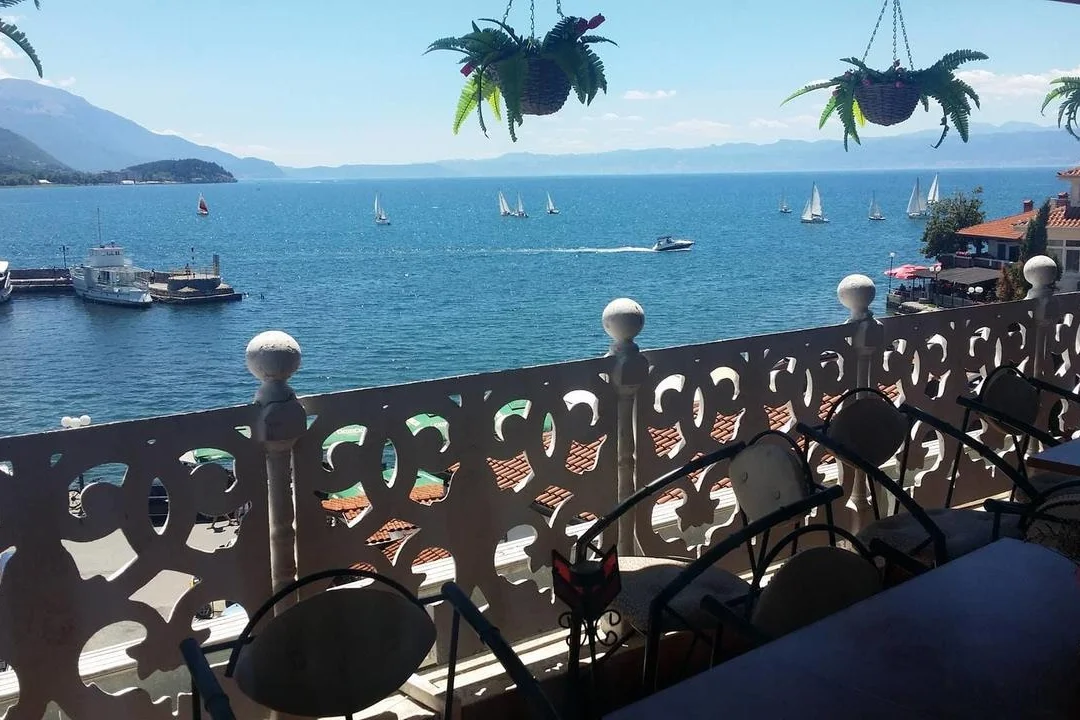
For my stay in Ohrid I chose the Boutique Hotel Tabana.
Located right in the heart of Ohrid, this hotel offers scenic lake and mountain views with very comfortable rooms that include a satellite TV and a private bathroom with a shower and free toiletries.
The staff is extremely nice and helpful, and they serve breakfast on the terrace. The building also has a cafe-bar on the ground where you can get food or a drink.
The facilitates are a bit outdated, but if you’re looking for a cheap stay in the heart of Ohrid, this place is a great choice! Prices are around €30 for a double room in high season.
All opinions are my own.


If you’re spending a few days in the lakeside city of Ohrid, you cannot miss one of the most sacred places in North Macedonia: the Monastery of St. Naum.
Located 30km south from Ohrid, there’s no better way to explore the monastery than taking one of the frequent boats that leave from the port. During my visit, I took a half-day cruise from Ohrid to St. Naum not only to explore this interesting monastery and its water springs, but also to enjoy the views wonderful of Lake Ohrid on the way!